

What Leaders and Professionals Need More of in 2026
Episode 332 - Natalie Moore joins me to explore what leaders and professionals need most in 2026: courage, self-awareness, emotional intelligence, and space to think. We also discuss burnout, work design, hybrid work, and how career pivots can happen through small, intentional steps.
The themes in this week's podcast episode are not really about personal reinvention in the lifestyle sense, but they're also not hot takes about work culture. They sit at the intersection, as so many issues do when it comes to career and our personal lives. How to we reinvent leadership, organisational design, career strategy, and human behaviour so we can cope with the new ways of working?
That is where many of my clients live. They are not junior workers trying to “find their passion.” They are experienced corporate professionals, senior managers, and executives trying to make good decisions in a labour market that has become harder to read, less forgiving, and more emotionally demanding.
Here is what I keep seeing in my coaching work.
My clients are not simply struggling with job search mechanics. Yes, they need resumes, LinkedIn positioning, networking strategies, and interview preparation. But those are not the only things making this moment difficult. Many are also dealing with return-to-office mandates they did not choose, leadership cultures that speak the language of wellbeing without redesigning work, and AI-driven hiring processes that make the market feel more opaque than ever. LinkedIn reported in January that nearly two-thirds of people say finding a job has become more challenging, while U.S. applicants per open role have doubled since spring 2022. At the same time, 93% of recruiters say they plan to increase their use of AI in 2026.
Those are not small shifts. They change how people experience work, how they think about security, and how they approach career planning.
In my conversation with Natalie Moore on The Job Hunting Podcast (332), what emerged most clearly was that professionals who are coping best right now are not necessarily the most confident. They are the ones who are able to think clearly under pressure, notice when an environment is no longer working for them, and act with intention before their options narrow.
That is why I think the new career risk for corporate professionals is not change. It is delay.
Not thoughtful preparation. Not patience. Delay.
The kind of delay that comes from hoping a workplace will return to what it was. Or assuming that a title, a long tenure, or a strong reputation will be enough to protect you. Or telling yourself that burnout is a temporary phase, that hybrid work battles will settle down on their own, or that AI is something you can ignore because it feels impersonal or beneath the kind of work you do.
For many professionals, that delay is becoming expensive. The illusion of stability is still costing people dearly
One of the most important ideas in the episode was Natalie’s “possibility mindset.” She used it in the context of leadership and wellbeing, but I think it applies just as strongly to career management. Too many experienced professionals are still trying to interpret the current market through an old lens: work hard, apply for lots of jobs, and the system will reward you eventually.
Sometimes it still does. But not reliably enough to build a strategy around it.
The gap between what employees want and what employers offer is widening
Gallup’s latest workplace reporting shows that hybrid work has largely stabilized rather than disappeared. Among remote-capable U.S. workers, hybrid remains the predominant model, and fully on-site work has not meaningfully surged. Hybrid workers now spend about 2.3 days a week in the office, and that number has not moved in the past year. Yet many employers continue to behave as if flexibility is a temporary concession rather than a structural feature of modern knowledge work.
My clients feel this contradiction acutely. They see companies talking about trust, agility, and performance while using physical presence as a proxy for commitment. They hear leaders speak about innovation while reasserting control in ways that suggest anxiety rather than strategy. They are not imagining this tension. It is real, and it is affecting decisions about whether to stay, whether to move, and what kind of organisation is worth pursuing.
The most successful professionals I know are no longer asking only, “What role do I want next?” They are asking, “What kind of system am I willing to work inside?”
That is a better question.
Because two jobs with similar titles and compensation can offer completely different futures. One can make you more relevant, more energised, and more visible. The other can drain your judgment, flatten your ambition, and quietly damage your health.
Burnout is not just an individual problem. It is a management signal.
This is where the conversation with Natalie moved beyond career strategy and into something more fundamental. We discussed burnout, and she made a point I wish more organisations would take seriously: resilience training may support individuals, but it does not fix the environment that is exhausting them.
I could not agree more.
One reason burnout is so often missed among experienced professionals is that high performers can carry dysfunction for a long time. They can absorb uncertainty, tolerate poor management, and deliver through restructures, budget cuts, and leadership churn. From the outside, they look fine. Inside, they are operating with very little margin.
Gallup’s 2025 workplace findings point to the same structural problem. Employee thriving has fallen, manager engagement has declined sharply, and full-time U.S. employees are working fewer hours than five years ago, driven by lower engagement, shifting priorities, and burnout. Gallup also found that only 37% of U.S. employees strongly agree they are treated with respect at work, matching a record low.
This is not a story about fragility. It is a story about design.
The workplace challenge now is not convincing people to care more. It is building environments where good people can sustain effort without constant depletion. That requires more than wellbeing campaigns and better language. It requires leaders to rethink meeting load, role scope, performance expectations, training design, and the assumption that more activity equals more contribution.
Natalie spoke in the episode about the need for “white space” at work. I think that phrase deserves more attention than it usually gets. White space is not laziness. It is where thinking happens. It is where judgment improves. It is where people recover enough to see clearly.
When professionals come to me feeling stuck, they often assume the answer is to move faster. More applications. More networking. More pressure. But in many cases, what they need first is not acceleration. It is enough room to assess what is actually going on.
Many careers do not need reinvention. They need reinterpretation.
There is another trap affecting experienced professionals right now, and it is subtler than burnout. It is the belief that if their current role or industry no longer fits, the only alternative is a dramatic pivot.
I appreciated Natalie’s answer when I asked whether career pivots require a big leap. She said no. The change can be incremental. Often the real leap is psychological.
This matches what I see in coaching.
A great many midlife career transitions are not about becoming someone completely different. They are about learning to reinterpret a career story in a new market context. A senior professional with deep experience in higher education may be more commercially transferable than she thinks. A corporate affairs executive may be able to reposition into stakeholder strategy, regulation, policy, or external engagement more broadly. A leader who has spent years inside one sector may not need to start over. He may need to learn how to translate his value in ways that fit the problems employers are trying to solve now.
That distinction matters because panic tends to produce poor strategy. When people believe they need a dramatic leap, they often either freeze or make themselves smaller. They apply too broadly, pitch themselves too vaguely, or cling to titles that no longer capture their true strengths.
The better path is usually slower and more rigorous. Start with pattern recognition. What problems have you solved repeatedly? What environments have brought out your best work? What kind of leadership have you thrived under, and what kind has depleted you? What skills are portable, and which need refreshing? What part of your identity is helping you, and what part is trapping you?
This is why I often resist the pressure to rush clients “to market.” Preparation is not procrastination. Especially now, when hiring is more competitive and less transparent, the professionals who do best are often the ones who are able to position themselves with precision rather than noise.
What about AI? Here's what really going on.
No essay about corporate careers in 2026 can avoid AI, but I think the conversation is often framed too narrowly. The issue is not simply whether AI will take jobs. The more immediate question for most professionals is how AI is changing the process by which work is distributed, assessed, and valued.
LinkedIn’s January 2026 research is instructive here. More than four in five people say they already use or plan to use AI in their job search, and nearly half say it boosts their interview confidence. Recruiters, meanwhile, are increasing their use of AI for sourcing and pre-screening, with many saying it helps them uncover qualified candidates they might not otherwise have found.
This creates both an opportunity and a hazard.
The opportunity is obvious. Professionals can use AI to sharpen their thinking, identify patterns in job descriptions, rehearse interviews, improve messaging, and speed up administrative tasks. Natalie made that point well in the episode. AI can create efficiency and support clarity. But she was also careful to say that it does not replace the human being behind the work.
That caveat matters.
The hazard is that some candidates will use AI to produce more volume rather than better signal. More applications, more generic outreach, more polished sameness. In that environment, judgment becomes more valuable, not less. So does discernment. So does the ability to communicate like a real person who understands context.
McKinsey’s 2026 State of Organizations report describes AI, economic uncertainty, and changing workforce expectations as three “tectonic forces” reshaping organisations. The report’s central point is not that technology is one trend among many, but that it is changing how work gets done, how structures are designed, and what leadership now requires.
That is why I think the professionals who will thrive are not the ones who treat AI as either salvation or threat. They are the ones who integrate it without outsourcing their judgment to it.
In the job market, that means using AI to improve your process while staying unmistakably human in your positioning. In leadership, it means using technology to enhance decision-making without abandoning empathy, context, and accountability. In career planning, it means accepting that fluency with new tools is no longer optional, while also understanding that the most durable advantage is still the ability to think well.
The capability that matters most now is courage
Near the end of the episode, I asked Natalie to choose between confidence, clarity, and courage as the capability that matters most this year. She chose courage. So did I.
That is not because confidence is unimportant. It is because confidence is usually downstream from action. People wait for confidence when what they really need is enough courage to act before certainty arrives.
My clients need courage to do a number of things that the market currently punishes, or appears to punish. They need courage to stop pretending that a prestigious but unhealthy role is worth preserving. They need courage to leave organisations that are shrinking their ambition. They need courage to explore different sectors or functions without turning that curiosity into a full identity crisis. They need courage to become more visible on LinkedIn, to network with more intention, to speak more directly about what they offer, and to accept that they are no longer early-career generalists who can wait quietly to be discovered.
They also need courage to face less glamorous truths.
That they may need to learn new tools.
That their old title may not carry the same market weight it once did.
That a long career can still be badly packaged.
That leadership experience does not automatically equal leadership relevance.
That wellbeing is not a side issue if their work is making them ill.
What makes this harder is that many experienced professionals have built careers on competence, not visibility. They are used to being the one who knows, who solves, who performs. To market oneself after years of internal credibility can feel undignified. To ask for help can feel destabilising. To admit that a career needs redesign can feel like failure.
It is not failure. It is adaptation.
And adaptation is now a core professional skill.
What I am telling clients now
If I had to distill the advice I am giving clients in this moment, it would sound something like this:
- Do not confuse motion with strategy.
- Do not assume your employer’s language reflects its culture.
- Do not wait for the market to become less competitive before you strengthen your positioning.
- Do not frame wellbeing as a private weakness if the system around you is poorly designed.
- Do not dismiss AI because it irritates you, but do not rely on it so heavily that your judgment becomes generic.
- And do not wait until you are desperate to start doing the reflective work that good career decisions require.
The people who are navigating this period best are not those with the neatest five-year plans. They are the ones who can read the environment clearly, understand themselves honestly, and move before drift turns into damage.
That, to me, is the common thread running through everything Natalie and I discussed. Leadership, wellbeing, hybrid work, burnout, AI, career pivots, and the future of work are not separate topics. They are different expressions of the same underlying challenge: how to build a professional life that remains viable, relevant, and humane in a market that is becoming less tolerant of passivity.
For experienced corporate professionals looking for work, or even just wondering whether they should be, the message is not that you need to panic.
It is that you need to pay attention.
Because the biggest threat to your career right now may not be disruption itself.
It may be the temptation to delay responding to it.
Want to be my client? Click here.
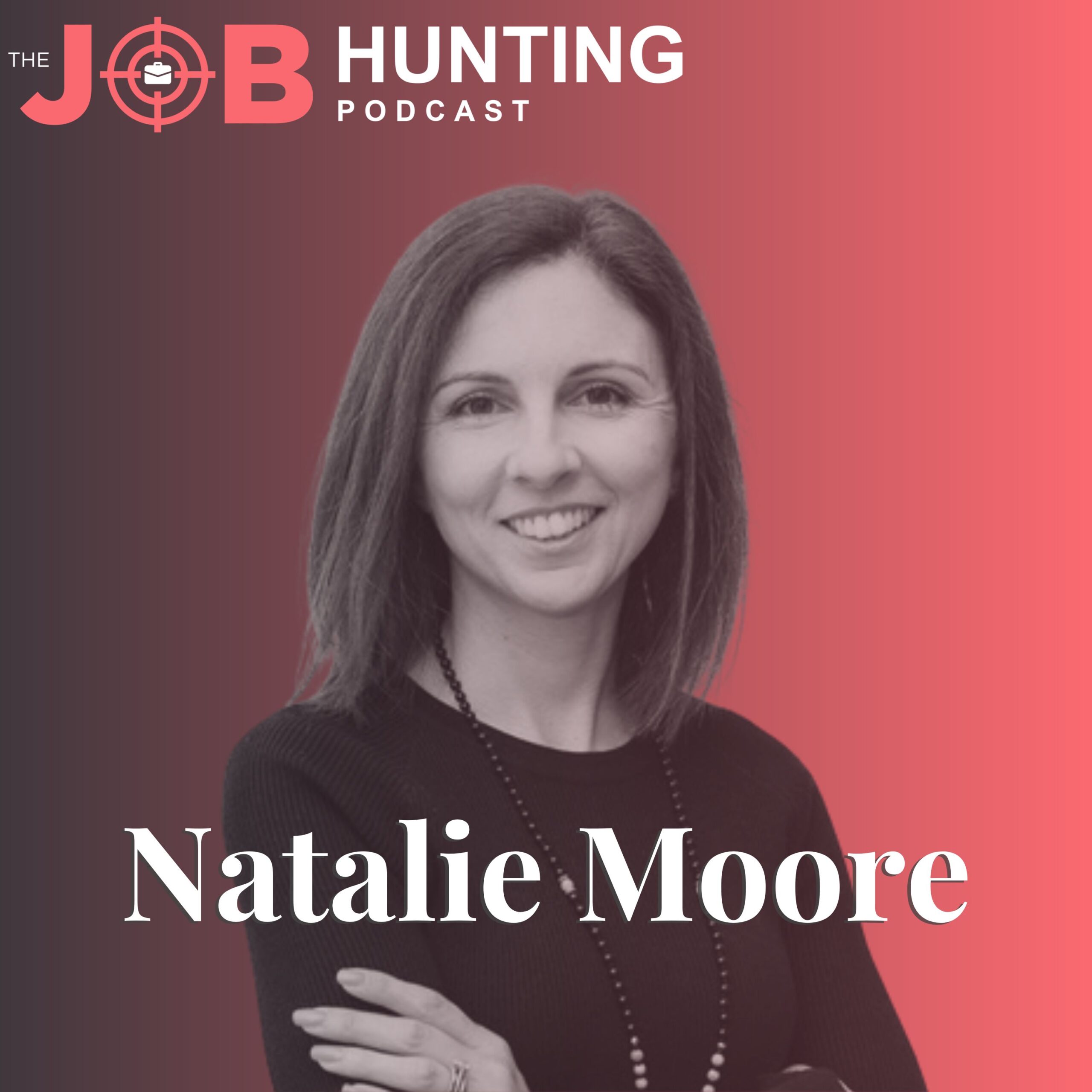
About Our Guest, Natalie Moore
Natalie Moore is a Coach, Leadership Facilitator and Business Strategist specialising in mindset, behavioural change and human-centred performance. With a background spanning leadership development, business transformation and wellbeing, she helps individuals and organisations reconnect with clarity, purpose and sustainable high performance. Known for her grounded, practical and compassionate approach, Natalie blends strategic insight with mind–body practices to create meaningful, lasting change. Her mission is to bridge leadership, strategy and wellbeing, empowering people to move from autopilot to aligned action and helping organisations build cultures where people and performance thrive.
About the Host, Renata Bernarde
Hello, I’m Renata Bernarde, the Host of The Job Hunting Podcast. I’m also an executive coach, job hunting expert, and career strategist. I teach professionals (corporate, non-profit, and public) the steps and frameworks to help them find great jobs, change, and advance their careers with confidence and less stress.
If you are an ambitious professional who is keen to develop a robust career plan, if you are looking to find your next job or promotion, or if you want to keep a finger on the pulse of the job market so that when you are ready, and an opportunity arises, you can hit the ground running, then this podcast is for you.
In addition to The Job Hunting Podcast, on my website, I have developed a range of courses and services for professionals in career or job transition. And, of course, I also coach private clients
Resources Mentioned in This Episode
Timestamps to Guide Your Listening
- 00:00 – Welcome Back: Natalie Moore Returns
- 01:11 – Reinvention After Closing a Business
- 03:10 – Headline Hopes for the End of 2026
- 06:42 – How Leaders Can Stop Reacting and Start Responding
- 08:59 – True or False: Can Resilience Training Fix Burnout?
- 09:47 – True or False: Will Good Workers Naturally Adapt to AI?
- 10:55 – True or False: Do Career Pivots Require a Big Leap?
- 12:42 – Three Questions to Ask When You Feel Flat at Work
- 16:45 – What Stress and Burnout Really Look Like in High Performers
- 21:45 – Listening to Your Body and Noticing Your Triggers
- 24:03 – What We’re Leaving Behind in 2026
- 25:22 – Showing Up Differently in Business and on LinkedIn
- 28:40 – Why Workplace Wellbeing Still Feels Surface-Level
- 30:32 – Is It Time to Redesign the Workday?
- 32:55 – When Training and Development Add to Burnout
- 35:19 – The High-Performance Habits That Need to Go
- 36:50 – Why White Space Matters at Work and in Job Search
- 38:08 – Natalie’s Career Change Story and the Power of Slow Pivots
- 39:21 – What Matters Most in 2026: Confidence, Courage, or Clarity?
- 41:43 – AI, Human Work, and What Still Makes Us Valuable
- 43:34 – The Human Capabilities Professionals Need Now
- 45:44 – Final Thoughts and Where to Find Natalie
Transcript
Renata Bernarde (00:21)
Natalie, it’s been what? Maybe three years since we last spoke. And it’s the second time that you are a guest on the Job Hunting Podcast. And, but the first time that you were alone. Where is Natalie?
Lisa, sorry!
Natalie (00:36)
Yes, well, we parted ways amicably, middle of last year, 2025, to pursue some of our own individual endeavors outside of our business, actually. So it is a little bit weird. This is probably one of the first podcasts on my own.
Renata Bernarde (00:49)
do you miss the companionship? I feel very lonely, I work by myself and I was kind of jealous of both of you always, having such a good vibe and a good energy between the two of you.
Natalie (00:59)
Yeah, I do. And as much as we’re both in a really great place individually, I think definitely having that camaraderie and that commonality in a goal and a passion, definitely missing that piece.
Renata Bernarde (01:11)
What did you do together that you’re really proud of?
Natalie (01:14)
we had lots of women when we decided to close reach out to say, you know, thank you for helping me say the word menopause. Thank you for helping me look into it. And some women who even said, you just, saved my life. And we could never have imagined that’s the impact that we would have had.
Renata Bernarde (01:30)
Definitely you and Lisa were one of the pioneers in Australia talking about menopause, especially menopause in the workplace. So that was so important. And that’s why I wanted you on my podcast as well. Now that you’re working for yourself, is menopause still a big part of what you’re going to focus on? How would you explain what you’re doing in 2026 and beyond to somebody that doesn’t know you?
Natalie (01:54)
When we closed the business, I moved out of that and come into my own career on my own. It was something that I had to be very conscious of that I need to drop that piece. Not so much drop it, but when you’re trying to create a new brand and trying to create a new area of work, I had to make a conscious decision that I couldn’t talk so much about menopause because I’m coming back into three loves, business leadership and wellbeing.
and want to bring, I guess, a new focus area and people to see me with the 10 years of experience I’ve got in business on my own, plus other career endeavors before that. I’ve had to shift that brand a little bit. So this year for 2026, it’s really about amalgamating those and seeing how business and leadership are not standalone from well-being.
And when I talk about well-being, I talk about the whole person. So physical, mental, emotional, spiritual, and also that purpose and fulfillment as well. If there’s one thing I saw across my work with women through menopause, it’s just that desire for that sense of fulfillment and purpose and satisfaction across their 40s and their 50s.
Renata Bernarde (03:10)
Yeah, no, I think it’s important to take that time to reflect, you know, once you reach a crossroad, which you and Lisa have done. And it’s so good. I love, you know, to reinvent yourself, reinvent myself. And we’re doing that somewhat at the beginning of the year as well. And that’s really great. Talking about sort of that cadence of a year long situation, I want to play a game with you, starting with this question about
what we both think will happen at the end of 2026. Like if I do this every year in terms of understanding what I want for my area of expertise and I try to think about headlines that I want to see, not that I can make it happen, but what I can foresee as something that will happen by the end of 2026 if possible in the best case scenario.
For me, it’s best case scenario. You can go whichever way you want, but I will start and then I want you to talk about your work in terms of a headline for December, 2026 about leadership and wellbeing. For me in my area of expertise in terms of job hunting and career planning, I would love December, 2026 to be the time when people realize that remote work and hybrid work are here to stay.
Natalie (04:04)
Yeah.
Renata Bernarde (04:26)
And that we stopped, especially with my clients in the US, we stopped this policy of making people come back to work full-time, which many of my clients are facing on both sides of the coast, know, East and West. And that’s why they seek me out because they don’t want to work full-time in the office and they have to find a hybrid, maybe remote option for them.
But I see this as a knee-jerk reaction of managers and leaders not knowing how to build a high-performing team that works hybridly or remotely. And that’s on their plate, not on the employee’s plate to fix. I think 90 % of the time there is an opportunity for people to work remotely and really be optimal at it. that’s my…
my wish for a headline in December 2026. What would be your wish?
Natalie (05:16)
Good question. My focus is really coming into possibility and possibility for an individual, but also possibility for organizations. And I think it aligns quite well to your wish as well in that let’s expand our mindset to have a possibility mindset. And we don’t have to have it figured out. We don’t have to have the full path planned, but let’s just…
⁓ nurture the possibility of whether it’s change, whether it’s looking at hybrid work or the possibility of really supporting our people around their health and wellbeing. Yeah, this year for me is all about possibility and helping people to just tap into that. So I’d love more and more individuals and businesses to adopt that possibility mindset.
Renata Bernarde (06:02)
I think especially for Generation X and even some of the boomers that are still working and good for them, that nostalgia of sticking to the past can become very set in their ways in the way that they want to run their businesses and lead their teams rather than, like you said,
adopt the possibility of doing things differently. And I think that’s really important, especially as we have such a diverse generation, generations working together in the workplace these days. What would you tell leaders to do now so they’re not reacting later or overreacting later?
Natalie (06:42)
Yeah, I’m very much about coming back to us and coming back to our body. And I don’t think we spend enough time in the present moment and nor do we spend enough time actually connecting to ourself. So when I think about, you know, how do we not be reactive, it’s really understanding.
how do we react to situations? So what is our emotional response to things when situations arise? And really understanding that and then using that as knowledge and as an opportunity and can I say possibility of harnessing that to support relationships, to support our curiosity around what our people need or also being curious about what we need as well. So yeah, definitely coming back to
where we are now to the present, and not forward looking to the future too much. just, yeah, where am I right now? What do I need and what can I do to support myself?
Renata Bernarde (07:40)
Okay. Mine is a kind of a version of that, even though I’m much more future oriented than what you’re suggesting. But what I wrote in my plan for this year, what would you tell leaders to do now so they don’t overreact or react later is to not overcommit to things in the future. Because the work I do is so much about planning, you know, like people sign up.
Natalie (08:00)
Mm.
Renata Bernarde (08:07)
to work with me because they want to plan their careers for the next decade or two so that they’re in control, et cetera. But I feel like that sometimes is misinterpreted with too much over commitment of things that they need to sign up for and do. Whereas I’d much rather work super slow and incrementally. That’s usually how I like to do things. And I feel like people can be very overwhelmed if they, yeah.
overcommit themselves, 2026 being a year that they need to do so many things. No, no, cut that in half, cut that by a third and then maybe focus on that. You’re so into wellbeing and I want to ask you a couple of true and false questions for you. I don’t have answers for those, though I really want to learn from you. True or false? Resilience training fixes burnout.
Natalie (08:59)
false, a big false. So resilience training supports individual and you we’re all hardwired for resilience and we can definitely develop and train that muscle, but it doesn’t necessarily change the environment or the system in which we work in. So I think, yeah, it’s really important that we support ourselves as individuals, but also look at how do we now bring resilience into the entire ecosystem and train that muscle within the environment we work.
Renata Bernarde (09:01)
Okay, tell me.
Yeah, no, I have seen a lot of very resilient people burn out harder than people that have less resiliency in their talent scores when I do the assessment for them. So I get it. Another true or false, if someone is good at their job, they will naturally adapt to artificial intelligence.
Natalie (09:47)
Again, I’m going to
say false and reason being is that AI is a tool, right? And, but it’s also, I don’t think it’s another tech technology tool that we’ve ever used, but what’s not something we’ve ever used before, but it’s very different to what we’ve used before. So I think there’s got to be a new way of learning around how to use AI, but how to use AI to enhance the way we work and support the way we work and also the way that we show up as well.
Renata Bernarde (10:17)
Yeah. You know, when people book discovery calls with me and I ask them what sort of jobs they want to do, sometimes, rarely, but sometimes it’s something along the lines of, I want to do anything that does not involve learning artificial intelligence or doing this or doing that. I just want to do what I have been doing. I know they’re not the client for me.
Natalie (10:37)
Yeah.
Renata Bernarde (10:37)
I think I can help you. It’s just so hard to find those nostalgic jobs. They’re dinosaur roles and they’re not there anymore. So, yeah, it’s good to hear from you about that. Another true or false, I have an opinion on this. Career pivots require a big leap.
Natalie (10:55)
I’m gonna say false again. Gone for the triple Pete with false because I think that we can create big change incrementally and small steps and.
Renata Bernarde (10:57)
Yeah.
Yes.
Natalie (11:05)
you know, if we’re going to be really intentional and I’m assuming the clients you work with, you know, they’re the sort of people who have an intention or they have a focus in mind around how they want their career future career to look. And in being intentional, we have to be methodical and we have to take small steps and also pivot. You know, I’m a prime example of that. We’ve got to pivot at certain times when things feel misaligned. So, yeah, small steps create big change. And I use a phrase ⁓
throughout my yoga actually, that a little goes a long way. And we can definitely adopt that same mentality when it comes to career change as well.
Renata Bernarde (11:43)
I agree with you. I think it’s also false. I think the big leap is less about the actual career pivot, but more inside your head. You know, it’s like a mindset change that needs to happen to allow you to think creatively about your career. It doesn’t need to be a 180 tomorrow.
but your mind needs to be ready to do the incremental change and to feel vulnerable and lacking in knowledge. Maybe for the first time in decades, when you’re doing a career pivot, you have to unlearn things and then learn new things. So I think the big leap is more here than anywhere else. All right. So…
Let’s say you have a client that reaches out to you and feels super flat, successful on paper, but really unmotivated. What are the questions that you would try to ask that person to uncover what’s going on?
Natalie (12:42)
Yeah, so a few years ago, I learnt these three question exercise from a well known associate professor, Michelle McQuade. I don’t know if you know her. ⁓ so she was Melbourne based actually working out of Melbourne University. I think she’s now in Canada, but
Renata Bernarde (12:53)
Where is she from?
Natalie (12:59)
She’s done a lot around positive psychology and I’ve seen her speak at a few different conferences and she always kept coming back to these three question exercise. And so first question is what’s going well for you or what’s working well? Second question is, is what are you struggling with? And then the third question is what do you need or what support or what learning do you need? So you could expand that dependent on the context, right?
And the reason I love that, and I do use that in, whether it’s coaching or in workshops, because it brings you back to, I guess, very much the basics in terms of where you are. So we have a moment of reflecting on what’s going well. We then have a moment of actually being really honest with ourselves to say, actually, you know what, this is not working. And then the third question is the learning opportunity for us and the growth.
Renata Bernarde (13:26)
Yeah.
Natalie (13:51)
⁓ learning goal around what is it that I need and is what I need some, you know, just to reach out to someone and have a conversation. Do I need to, you know, research some things? Do I need to change this or do this? And so I always start any session with that three question just to help, yeah, bring people back to where they are. And then then I feel like once you’ve got that last question really solid,
Renata Bernarde (14:09)
Okay.
Natalie (14:17)
We can then expand and look and say, okay, where do we go to from here? What’s the next step?
Renata Bernarde (14:22)
I think that that’s great. I have a version of that inside my client platform, but it’s like a whole, like two pages of questions that people need to answer before they have the first coaching session with me in my program. But yeah, I think it’s the most important thing in my view is writing them down. I think it’s so easy or saying it out loud, you know.
Natalie (14:29)
Yeah.
Renata Bernarde (14:46)
by yourself or with a coach or with a mentor. But ruminating on these things on your own can be very detrimental for mental health, I find. And I think that people keep a lot of those thoughts and ideas and reflections inside their heads and they don’t verbalize them, they don’t journal. And that’s when I think things can really spiral down if they don’t do that. So I think that’s the benefit of…
either journaling or working with a coach. So that’s really great. one of the things that I, I mean, we are different, we offer different types of coaching services, but they are complimentary and, and, know, somebody may want to do coaching with you for a period of time and then coaching with me for a different time. And that’s, and that’s fine. But we, we probably overlap in terms of the types of clients that we, we have.
And I’m assuming you also have this sort of client, which is like somebody who is very experienced, most likely a leader, senior executive, or a manager with lots of responsibilities, lots of important KPIs that they need to achieve. So they’re usually very high performing, but they’re constantly tense and reactive. I was talking to somebody, I think yesterday, one of my clients,
And we were talking about the fact that for so long, she was always wired for stress, wired to be reacting to everything. I don’t think people think about it, but waking up in the morning every single day for over a year, if not more, to know that you’re going to work in an environment where your boss is
for lack of better word, an asshole. I’m just talking about that book that I always talk about, the asshole rule So that book, and the team is struggling and there’s lots and lots of restructures happening, lots of people leaving, and then eventually she left as well. So day in, day out, day in, day out, they come to me as clients, so tense, so reactive.
Natalie (16:22)
Thank
Renata Bernarde (16:45)
Where, if that happens to you, if you have a client like that, where do you start?
Natalie (16:49)
Yeah, and I see it so much. And can I say that’s where I was nearly 10 years ago. And that was the catalyst for me in making a career change because I was so stressed and tense and actually not even realizing that that’s what I was experiencing. And also until I studied stress and what it does to the body. yeah, this is quite an area that I’m very interested in and love talking to people about.
But essentially it comes back to what I was talking about earlier around that connection to what we’re feeling in the body and the emotions in the body, because our body is always talking to us. And of course it’s our nervous system and it’s our adrenals that are being impacted when we are deeply stressed that we need that time to actually try and slow things down a little bit.
being yoga and meditation teacher, one of my key areas is really helping people to bring the breath back into their day because we all breathe, but we forget to breathe or we forget that we’re breathing. And that is one of the greatest ways that we can actually start to just slow things down and again, bring ourselves back to where we are. I have another question that I ask people and I often encourage them to ask themselves this every morning when they wake up.
and even journal, write it down, what am I feeling? Because I think we never ask ourselves what is it that I’m feeling and that just in itself opens up the opportunity to not feel what we’re feeling in our head but actually feel what we’re feeling deep in our body and that’s a real catalyst again to say somebody’s not feeling right.
Renata Bernarde (18:10)
you
Natalie (18:28)
I’m feeling off, I’m not feeling myself, perhaps feeling misaligned, feeling deeply stressed or on the verge of burnout. And yeah, it’s a great question to just explore. But of course, we want to ask it over a bit of a period of time.
Renata Bernarde (18:40)
Yeah.
Natalie (18:43)
particularly if we’re thinking about change, we could ask ourselves once and we could get one answer and the next day we could get another answer. But this is about trying to build that pattern and an understanding of, what is it that I’m experiencing and why am I experiencing it? And in connecting to our body, that helps us then to connect to the thoughts that our emotions are creating.
but then also brings us back to, what are the beliefs that I’ve got that are also creating these thoughts? Because we possibly have beliefs around how we should be working and how we should be showing up. And if we’re not meeting those expectations, then we have thoughts of self judgment or self loathing. And then that creates feelings in the body of, know, disgust or shame.
Renata Bernarde (19:04)
Yeah.
Natalie (19:25)
So yeah, you probably see there’s a pattern here in the way that I work with people initially is just, yeah, coming back into the body and asking, you know, what am I feeling? And using that again as information to support our next step.
Renata Bernarde (19:36)
Natalie, you know, one thing that I wish I knew better 10 years ago, 20 years ago, and I’ve only recently started to notice is are my triggers, you know, the physical manifestations of my stress. And I was discussing it with my my specialist. I was seeing him on Monday and he had a list of triggers. So he was asking me, do you feel this? Do you feel that? I’m like, yes, yes, yes, yes. And then there was one that he didn’t ask.
and I had to tell him and it was like such a weirdo because I’m such a weirdo. It was a weird one. So my trigger that I think is most telling to me is I start hearing noises that other people don’t hear. Like when you flick a switch to turn on a light, I hear a very sharp noise. When there’s a battery or anything charging next to me, I hear the noise of the charging. You’re not supposed to hear it, but I do. And that’s when I know I’m flaring up.
That’s when I know I’m not in my comfort zone. I’m in a fight and flight zone. And that’s the first thing that shows up. If I don’t pay attention to that, then I start having like blurry visions and some, know, when I was working in the corporate world, it was really embarrassing because I had an outward facing world and I always had a red eye. Like it would have that sort of effect on me. Just the stress of the work would cause that sort of manifestations on my health. I have a lot of clients that have IBS.
or if they have ADHD, the ADHD will just get worse even under medication. So knowing your triggers, I think is so important, isn’t it? And it’s what you said, like we don’t touch base with our feelings and then our body starts showing that there’s something wrong and then we don’t pay attention to that as well. So fascinating.
Natalie (21:18)
Yeah.
Yeah, our body’s always talking to us and because we are so busy and we’re so in our head, you know, we’re not taking the time to stop and listen and feel. And, you know, I think what you’re highlighting there with your experience is the senses. We get a sense of overload and it’s your particular sense of hearing that obviously heightens at a moment of stress. I feel it deep in my belly. I get that feeling of, you know, butterflies or something in my belly. And straight away I know that
Renata Bernarde (21:22)
Yeah.
Natalie (21:45)
Okay, I’m in a situation that is going to elicit the fight or flight. I need to just breathe and stop and take a step back and choose my response. And I think if there’s one thing I can say about stress, we can’t always eliminate stress. We can’t always minimize it and there’s stress all around us, but we can actually choose how we respond to stress and coming back into our body is a really great way to do that.
Renata Bernarde (21:46)
Mm.
Do you run breathwork workshops?
Natalie (22:13)
⁓ I was doing a lot of yoga meditation in the past through the business, but because I’m in this sort of phase of pivot and a bit of transition, I’m not yet. I’m going to say yet at the end. Yeah.
Renata Bernarde (22:17)
Yeah.
Okay,
okay. Because I’ve done one with Josh Pitterman here in Melbourne. I’ll put a link below because he’s running quite a few this year. And I think I need to do more. I did my first one. It was like a whole day. And I it’s a lot, isn’t it? Like, I have you done one like I didn’t expect it to be so emotional and so important. And I was sometimes kind of.
sort of feeling very self-aware and not really engaging with the exercise as much as I wanted to. So I want to do another one. I think he’s running another one before I go away to Europe. So I’ll try to do that. ⁓ I promised him that I would take his mother with me who has been a guest on this podcast. So I’ll link her as well in the episode show notes. So Hannah Pitterman she’s an amazing coach and consultant. So I think breath work is
is amazing and we’re only sort of tip of the iceberg of what we can do with with our breaths. So, so interested in and Josh is so knowledgeable, having been still is, you know, an amazing singer. Of course, he has that background of, you know, knowing how to breathe. I don’t know how to breathe. People make fun of me because sometimes I do forget to breathe and I will cough like at work. I remember people
noticing that I was either sighing or coughing because I hadn’t sort of breathed for a minute or two. I’m just too worried or stressed about an email or a conversation or something and I would just stop breathing, which is ridiculous. So I really need to work on that. Another fun thing for us to do, two things that you will stop doing in 2026.
Natalie (24:03)
Ah, good question. Definitely pushing. pushing in terms of over striving, might I say. So given the work I was doing around menopause, I can reflect and say that I was really striving to create the And, you know, I guess a reason why we stopped the business is because we saw that
there’s still a really long way to go. And we sort of got to the point that we said, we can’t wait for our own sanity. We can’t wait for workplaces to be ready. And so I can see over that six years, there was a lot of pushing, a lot of striving to get people on board, but realizing that things take time and divine timing, things will happen as they need to happen. So big part of me is yeah, not,
pushing or not over striving might I say? Still taking action, but not trying to force outcomes. I think that’s probably more to the point. And then what will I keep? was the question? Keep doing? Yeah. I’m not. Yeah. Start doing.
Renata Bernarde (24:57)
Keep doing, yeah. Or start doing, maybe start doing if you haven’t started yet.
Natalie (25:04)
Yeah, I think I’m going to show up a little bit differently to how I have again in the past because I am solo on my own and I’ve got a new message, sort of a, I guess a new focus or refined focus and just, yeah, showing up differently.
Renata Bernarde (25:22)
For me, I decided to do the podcast once a fortnight instead of once a week. And that has been such a hard decision for me because I was just so set in my ways and I love routine and I don’t like to change routines. Even if they’re not working, I just stick to them so strongly. But I think it’s for the best. So last week was the first week where I didn’t release an episode.
And I think my biggest fear is that it will impact my business getting clients because most of my clients come from listening to the podcast. But it was fine. Like I got two new clients last week. I mean, it’s the beginning of the year. So it’s usually the time that people do sign up for coaching, especially job hunting if they’re looking for work. So, but it was just such a good, know, finally I can do this and I can have a bit more time for other things.
Two things that I will start doing is, gosh, I’ll put a link below to what I did a couple of weeks ago, which was basically just showing up more courageously to people, like being more overt about the fact that I am a coach and I need clients and please sign up and work with me. It’s different from listening to the podcast. I think I spent the past six years doing this as a newbie, whereas like, no, I’m actually
good at this shit. Like my clients all have jobs, they’re happy, none of them are complaining quite the other way around. Word of mouth is great and it’s time, you know, so I need to start sort of elevating my, the way that I show up. Cause I show up a lot, Natalie, you know that, like I’m always on.
If anything, I’m doing less of that this year, but I’m showing up a bit more strongly, I think. I hope it doesn’t rub people off the wrong way. It doesn’t seem like it did because I wrote a big manifesto, like a Jerry Maguire of weeks ago, LinkedIn. And it went all right. So yeah, so that’s it. Are you doing anything differently in the way that you’re working?
Natalie (27:20)
I’m definitely, you know, like when it comes to social media and as a business owner, you know that you’ve got to find your channel on on where you are and have dabbled in them all over the last six years, but been very intentional around LinkedIn and intentional on Substack as well. And I really feel I’ve got a message and a story and I guess a thought provoking
Renata Bernarde (27:39)
okay.
Natalie (27:46)
way to help people really nurture that possibility mindset. So I’ve been very intentional on those two platforms and writing more. So doing a little bit more writing. And I’ve had a podcast and I really do miss the podcasting. And so for me, again, not rushing or trying to force it, but feel like there’s something that might come with that eventually as well.
Definitely very intentional. I’ve definitely come into 2026 very intentional and a little bit like you, you know, over the years I felt like a newbie and on reflection towards the end of last year.
I just remember thinking, no, I’m good at this and I’ll go and facilitate a workshop or a program or I’ll coach. I mean, I know what I’m doing and I know I can help people. And so I’m really nurturing that mindset of just, yeah, go out there and unapologetically and but intentionally.
Renata Bernarde (28:40)
With the workshops that you have run in organizations around Australia, it has given you such great insight, you know, as that external perspective looking in. What have you observed about workplace culture that if you could change it, like wave a wand and change it, that you would?
Natalie (28:59)
yes, I feel like I’ve been waving a wand for the past 10 years around wellbeing and it’s still not changing. I do think wellbeing is still seen as very much a nice to have and a tick the box exercise. And you know, I started my own business, my daughter was only one. And I remember I set my intention back then that by the time she’s working full time, wellbeing will not be a nice to have, it’ll just be part of the culture and she’ll be seen for who she is and where she is and
Renata Bernarde (29:06)
Yeah.
Natalie (29:28)
she’ll be supported to be the healthiest best and she’s 11 now. And so we’re still not there. We are doing things, but we’re not doing things that really change in the culture. It’s very surface level. And so I love facilitating a workshop, but unless I’m in there actually creating real cultural change, it’s not gonna have the impact that we want it to have.
and people are not going to take the learning or the behaviour change that I share and put it into action. They can’t because yeah, and if I think about the menopause piece, and I often said that we’ve never had the vocabulary around the word menopause.
And we need to build the literacy around the what and the why and the support that we need. And not just for women, but for men and really understanding we all go through life phases and changes. And we need to do the same with well-being. We need to build that literacy and really not see it as a buzzword, but see it as something that is deep in the core of who we are and how we show up and how we work.
Renata Bernarde (30:10)
Yeah.
Yeah. Talking about that, and you mentioned your daughter as well, and I’m thinking here, is it time for us to redesign the workday of, especially the type of clients we see, know, knowledge workers? What would you do if you could with the way that we work, the nine to five kind of expectations that people have?
It just seems so wrong now, especially for people that are working hybrid or remote.
Natalie (31:02)
Hmm, yeah, it feels so archaic, doesn’t it? And even, you know, coming off school holidays and speaking to so many friends, it’s the same thing. It’s like, how is the work year so misaligned to the school year and how we expected to work? You know, my daughter was sick day one of this year and I had to go into the city and do a face-to-face, but she was sick and so I actually couldn’t go in. So I had to change it to all online, which was fine, but.
Yeah, it’s really frustrating. again, I think education really has to play a big piece. I don’t think we’re really curious or open minded to
what change, know, changing the how the hours of the day, what that could actually do for productivity and what it could do for performance and how long people might stay in the workplace for as well. You know, I speak to some leaders who are worried about doing certain things, different initiatives, because they don’t want their people to leave. And I always say, you know, if people are eventually going to leave at some point, right?
And if they can look back and say, I had an amazing experience at this organization, they then become an advocate for that organization for future employees, why not? Let’s give them the best experience whilst they’re there. So I digress a little bit, but I think, yeah, we need to really have education. We really need to have a curious mind. And we also need to just
be people and be humans and understand each of the circumstances that everyone’s got. And how can we be adaptive to that? I look at some of the big organizations I saw.
can’t remember his role, but someone from Medibank who’s been a catalyst around the four day working week that they’ve got there. And, you know, he spoke so highly around the increase in productivity and the morale. So we’re seeing organisations doing it here in Australia and they’re having really great outcome in making certain changes.
Renata Bernarde (32:55)
when you’re working one-on-one with clients, sometimes there are two organizations, same industry, same country, completely different cultures. It’s so fascinating to see. I sometimes have clients in the same organization, but with different managers and completely different work experiences. But one of the things that I have
Natalie (33:14)
Yeah.
Renata Bernarde (33:16)
been observing is this idea that some organizations have built their training or professional development program in a way that accidentally or not on purpose, enhances the burnout potential because of the way that the training is designed. With all the best intentions, it’s either a matter of too much training
or the facilitators that come are too eager to present and just makes everybody a bit sort of anxious about what they need to do in order to be great high performing members of the team. And they come to me for coaching later feeling quite deflated by the fact that they couldn’t keep up with the expectations of the training that they have received.
Have you observed that as well or is that too niche?
Natalie (34:08)
No, I think it is a problem because again, I think we’re very much of a mindset around more, more, more. ⁓ And as a trainer and assessor, and I’ve worked at a few universities as well as doing workshops in workplaces, there’s a particular structure that you want to take when you are teaching. So you want to have a bit of content, but then you want to open up for some interactive engagement or interactive activities. It doesn’t have to be a full block of
Renata Bernarde (34:15)
Yeah.
Natalie (34:36)
of teaching, you know what I mean? Or expectation that we need to just keep giving people more and more, more, more, more information. You know, there’s little nuggets that we can give people that they can then take an action. And I think that’s the really big piece and probably one of my frustrations when it comes to health and wellbeing in the workplace that it’s just always about information and knowledge. Yes, we need that, but we need to create the space for people to action it.
on their terms as they can. We’re not cookie cutters, we’re not clones of each other and different things make us tick, our brains work differently, everything operates differently, right? And so we need to create that space for people to actually enact and put some of that into action.
Renata Bernarde (35:19)
Do you think there’s a high performing habit that has been sort of popularized in culture and corporate culture that is damaging?
Natalie (35:28)
Mm, 100%. Yeah, more,
Renata Bernarde (35:31)
Give me an example, which one would you retire if you could?
Natalie (35:37)
Just this notion of, you know, we have constant meetings, don’t we? Like we, and from each meeting there comes a series of different actions that we’re then expected to do. But by the time you have back-to-back meetings, your work days ended. And so when do you do those actions? So I think, you know, we’ve really got to create white space. You know, I talk about white space in our life.
Renata Bernarde (35:54)
Yeah.
⁓ I love that.
Natalie (36:02)
but in our work day, we need to create white space. So we need to have times of reflection, times of just on our own doing our work, but also have those times of real.
high intensity action too. I run marathons and I take a lot of my learning from all the marathons that I’ve run that I set a future goal, but I come back to the very beginning and I train my body. But in training my body, I’m not just training it physically.
I’m trained at mentally as well. So I do a lot of yoga and mindset work to train it mentally. But then I’m also focused on my sleep and I’m focused on my nutrition and I’m focused on the rest, right? More so than anything, that white space. you know, we need to almost adopt that mentality of training like an athlete.
Renata Bernarde (36:50)
I love that. Love that. You’re so right. And I think one of the hardest things I have to do with new clients, I had one this morning and she emailed me after the session asking for a couple of things and I will have to go back and explain to her is this idea of moving into action too quickly, you know, and that’s something that is
We are educated to do that, to achieve quickly as we start a new job, as we start job hunting and so forth. Whereas I’m a big believer in pre-work. So before going to market, it’s not procrastination, it’s just preparation really. And if you’re hiring a coach, you might as well benefit from the knowledge that in my case I have about how to best look for work.
to setting her expectations so that she knows that we will eventually get there. But right now is not the right time. We still need to do a little bit more of the preparation self analysis. And I need to understand her a little bit better before we go into, I mean, if I was a new coach or an insecure coach, I would want to please her and say, oh yeah, let’s, you know, that’s what she wants. She needs it now. Let’s do it.
But I’m at a stage now where I know that we will do a much better job for her if we take a step back before we go out to market very quickly. that’s, yeah.
Natalie (38:08)
Yeah, yeah, yeah. Could I share
a personal story? So back in 2016, and this was me in my career in manufacturing and sales, and it was about this time that year, so yeah, 10 years ago, and I said to myself, by the end of that year, I think it was gonna be 34 at the end of that year.
Renata Bernarde (38:13)
Yeah.
Natalie (38:27)
I said, I’m going to be in a new career. Now, I didn’t know what it looked like or what it meant, but I just knew that that was going to be my focus for the year. And I gave myself that full year. originally, I came up with a side hustle, just a small business that I came up with. And I didn’t quit my job straight away. I was in that career still. But having that little side hustle is what helped me have that sense of purpose while doing the career and the work I needed to do to have an income, et cetera.
But I gave myself that full year to just explore and be curious and try things, experiment with things. And eventually, you know, I got there. But and it actually didn’t even happen at the end of that year. It happened two years later. But I was fine. But I’d set that intention that this is this is my focus for the year. I’m not going to turn everything upside down. I’m just going to be, yeah, connect back to myself. I was very stressed. Values my why, you know, all those sorts of things.
Renata Bernarde (39:21)
Awesome. I love that. That’s such a coincidence because 10 years ago was also when I started coaching as a side hustle. Yeah. Yeah. So that’s interesting. Okay. What do you think for knowledge workers is more important this year? Confidence, courage, or clarity? I know you want to say all of them, but choose one. ⁓
Natalie (39:44)
There’s
definitely one that resonates most and that’s courage. And I think mainly because in a world of AI, and I know there’s a lot of people who don’t like AI, we have to find ways to harness AI and be courageous in showing up using AI. So particularly as a business owner, we’re out there marketing ourselves, but even people looking for work too.
Yeah, we can use AI to support what we need to do behind the scenes, but AI doesn’t replace the person, doesn’t replace the human, the personality, the emotions that we feel. And so it is going to take courage to show up with all of that in a very AI driven world. So I’m going to say courage.
Renata Bernarde (40:27)
I always say courage. I’m such a big fan of courage. I talk about courage all the bloody time because job hunting is really, you know, it makes you super insecure and lacking in confidence. When people come to me and they say, I need you to help me with my confidence. And I’m like, I’m not sure that I can do that, but I can help you be courageous. Right. So courage is something that I can help you with. And then over time you will become more confident about.
Natalie (40:28)
there.
Renata Bernarde (40:55)
job search and career development. But clarity, dear, I’ve given up.
Natalie (41:01)
It builds over time, right? Doesn’t it? Like it’s been courageous to take that first step that builds confidence, that’s confidence in action. And then clarity starts to form. But then you know what? Then you have a pivot and then you have another change and then you got to be courageous again. It’s like this cycle.
Renata Bernarde (41:03)
Yeah. Yeah.
Yeah. And AI is just everywhere and it’s in job search, know, on both ends, you know, for the job seeker using it and also the recruiter and how they go through hundreds of applications. It’s machine learning, bots, AI and all of that.
It’s also taking more and more of the work away from us. don’t know. Has it taken some of the work away from you? Are you using AI? And what do you do with the time that you have now that AI is doing some tasks for you?
Natalie (41:43)
Yeah, I
Yeah, so I think AI has definitely helped with a bit of efficiency, but also more so just getting very clear on messaging as well and helping me to solidify my thought leadership, the conversations that I want to have. But also, I don’t feel like it’s freed up too much time in the sense of I’m still very conscious about being a human and still showing up as who I am.
so it’s helped with efficiencies But yeah, for me as a person, I keep coming back to, yeah, I’ve got to keep showing up as me.
Renata Bernarde (42:21)
Yeah, I think I was reading yesterday, I think it’s called a scan report, something that advertising agencies do to kind of give people a clue on what to focus in the year and the year ahead. And they were talking about going back to analog. They were talking about going back to love, you know, like this is an agency, not just something that people are interested in career But I think.
Some of the things that have happened for the past couple of months, you know, in terms of pop culture and what’s, you know, trending right now made them think, okay, now that we’ve had enough of AI or, or internet or hybrid or remote, you know, we want to see people face to face. You want to have real connections. And I thought, this is interesting because I have been thinking about having meetings. You know, I usually do clients virtually, I’m.
Natalie (42:57)
Yeah.
Renata Bernarde (43:13)
Even with the podcast listeners, I have been thinking about running some events where people can just get together and meet me and have conversations since I’m going to be overseas as well. I can do it in different parts of the world, which will be nice. I don’t know when this episode is going out, everybody, but look in the episode show notes if I am running events, you can come and attend them.
Natalie (43:19)
Yeah
Bye.
Renata Bernarde (43:34)
Because I think that that human connection is coming up with something really important. Last question for you, Natalie, if we have to focus on one or two capabilities to work on for 2026 and beyond, what would it be? What do you think from working with your clients and with workplaces?
that humans need to work more as a muscle to grow and be more capable in doing.
Natalie (44:00)
I’m going to say, they probably, you know, always inverted commas, the soft capabilities, but again, you know, there’s a theme to what I’m passionate about.
I think emotional intelligence is one of the greatest superpowers that we are just not nurturing. And that then becomes self-awareness. So understanding self-awareness, motivation, empathy as well. And if I think about what you shared there from that agency around love and not love doesn’t even have to be in a romance context, but just showing love and spreading love and having kindness, emotional intelligence is something that really helps support build deep
relationships. And again, I just don’t think we can get away from that. And I don’t want to. And I don’t think we should be excited to be behind a robot. So I think emotional intelligence. And then of course, again, I think another great one is mindfulness. And it comes back to creating those white spaces, opportunity to be present.
to focus on where we are, who we are, who we’re becoming. I saw a great post on LinkedIn about, at 18, we’re expected to work out what our career is for the next 40 years with the notion that we won’t ever change or evolve. And then when we do, everyone’s like, you’re doing something different or what’s wrong with you, but you do this and now you’re doing this. So again, we’ve got to be very mindful of our growth.
and our evolution and not just in our biology, but the evolution in our mind and our fulfillment and what it is that we want. I think yeah, emotional intelligence and mindfulness are some real human capabilities that we can keep nurturing.
Renata Bernarde (45:44)
love that. Natalie, it has been wonderful to talk to you again. had such a great time the first time we had a conversation together with Lisa and I’ll put the link below to that one. But it’s nice to have a chat with a fellow coach and have a conversation about topics that are dear to me and dear to you. You’re wonderful. I will put a link below for people that want to reach out to you and work with you and hire you. And I hope that you come back, you know, year or two to have another conversation.
Natalie (46:12)
⁓ I would love that. Thank you so much, Renata. It’s always a pleasure chatting with you. Thanks, bye.
Related Posts

7 Strategies to Navigate Career Uncertainty
Burnout and Ambition: Why Rest Is a Smart Career Move
How Kindness and Giving Protect Your Career After Layoffs
Why Agency Matters More Than “Success” In Your Career
How Underrepresented Professionals Reach the C-Suite