



There is a particular kind of career dissatisfaction I see frequently among experienced professionals. They are successful by conventional measures. They have seniority, expertise, a respectable salary and two or three decades of professional history behind them. Yet increasingly, they feel uneasy about the idea that the next ten or fifteen years of their working life should look much like the last ten or fifteen.
The problem is that many people interpret this uneasiness as evidence that something dramatic needs to happen. They imagine leaving their employer, retraining completely, launching a consultancy, buying a business or finally pursuing the idea they have been quietly carrying around for years. Then reality intervenes. There is a mortgage, children at university, aging parents, a lifestyle built around a certain income, and a professional reputation that took a long time to establish.
This is where the conversation about career change can become unnecessarily binary. Stay or leave. Corporate career or entrepreneurship. Employment or consulting. Security or freedom.
My conversation with Australian lawyer, strategist and entrepreneur Kate Dillon offered a much more useful possibility: perhaps the next stage of an experienced professional's career does not require abandoning what came before. It may instead involve building outward from it.
Dillon has created the sort of career that can look carefully engineered in retrospect. She trained as a lawyer, pursued qualification in New York, built the professional handbag business She Lion, developed roles in strategy and employee experience, and now works across speaking, strategic advisory and executive development through her work as the creator of Opportunity Architecture™.
Yet one of the more useful admissions she made during our conversation was that the path was nowhere near as curated as it appears.
“I wish I could say, with the benefit of hindsight looking back, it was so curated and strategic,” she told me. “And that would be entirely incorrect.”
There was ambition. There was considerable work. But there was also experimentation, failure, unexpected opportunity and course correction.
That distinction matters because we have developed a tendency to retrospectively turn careers into neat narratives. LinkedIn encourages it. Professional bios encourage it. Conference introductions certainly encourage it. One role supposedly prepared us perfectly for the next, until everything culminated in the impressive person standing before us today.
Real careers rarely work like that.
The evidence increasingly suggests that career mobility later in life should not be considered unusual. An OECD analysis of longer working lives argues that rising longevity, digital change and economic transformation are making more varied career trajectories increasingly common. More interestingly, its analysis found an association between midcareer job changes and remaining employed later in life: among the countries studied, people who changed jobs between ages 45 and 54 were more likely to still be employed at 60 than those who had not made such a change.
The implication is not that everyone over 45 should immediately change jobs. It is that mobility and experimentation should not be regarded as behaviors reserved for people in their twenties.
For an experienced professional, the better question may be: What can I build from what I already have?
One of my favorite moments in the conversation came when we discussed the fear many professionals have about “starting from scratch.”
Dillon rejected the premise.
“No one does,” she said. “You don’t go into [a new role] with a clean slate.”
She is right. Yet many capable people behave as though changing sectors, moving into consulting or creating something new wipes twenty years of professional development from the ledger.
It does not.
You carry your judgment. You carry your understanding of organizational politics and decision-making. You carry your networks, pattern recognition, communication skills, industry knowledge, commercial awareness, leadership experiences, failures, successes and accumulated understanding of how people behave when the stakes are high.
The challenge is not accumulating career capital from zero. It is learning how to translate existing career capital into a different context.
This distinction becomes increasingly important as careers lengthen. The OECD Employment Outlook 2025 notes that longer lives and later retirement will require more attention to the employability, learning and career mobility of mid- and late-career workers. Employment rates have increased significantly among older workers, but the OECD also warns that policy and employer practices have not always kept pace with longer working lives.
For individuals, this makes the ability to reinterpret your experience increasingly valuable.
A senior executive moving into advisory work is not beginning an entirely new profession. A communications director who begins teaching is not discarding her career. A CFO who joins boards is not suddenly becoming someone different. A corporate leader experimenting with a small consulting practice is testing another application of capabilities developed elsewhere.
Dillon described this as becoming more conscious of “which of those muscle memory reflexes and experiences you can repackage to be more useful and distinctive in this new environment.”
That is a much better framework for career reinvention after 40.
Do not ask only: What else could I become?
Ask: Where else would what I already know be unusually useful?
Experienced professionals sometimes have a disadvantage when it comes to career experimentation: they can afford less uncertainty, but they also tend to believe every experiment has to be significant.
It does not.
During our interview, Dillon described an earlier period when she wondered whether she should move from law into fashion. Rather than immediately resigning and enrolling in another qualification, she began speaking to people whose careers intrigued her. She met people working in fashion buying and other roles she imagined she might enjoy.
The conversations gave her information she did not possess from the outside.
Some people told her she was overqualified. Others pointed out that she would effectively have to start at the bottom. The process helped her understand that the career she had romanticized was not necessarily the career she wanted. Eventually, a different possibility emerged: creating the product she could not find herself.
This is something I encourage in my coaching work constantly.
Career experimentation does not have to begin with resignation.
It can begin with five conversations.
It can involve a short course, an advisory project, volunteering for a different assignment, publishing articles about a subject you want to become known for, mentoring someone in another field, testing a small paid service, joining an industry association, or spending several weeks investigating how people in a particular profession actually work.
The objective is not merely networking. It is evidence gathering.
Dillon described it as taking action so that you have “more feedback on whether you keep going in that direction or you need to course correct.”
This is a much more sophisticated approach than sitting alone and trying to think your way into the perfect career decision.
For professionals in their 40s and 50s, the issue is especially relevant because we often become less willing to experiment precisely when experimentation could be most useful. We have accumulated expertise, which creates confidence in familiar settings but can make being a beginner feel uncomfortable. We have reputations to preserve. We are also more aware of what can go wrong.
Yet refusing to experiment has its own risk. It leaves us making high-stakes career decisions based on imagination rather than experience.
Portfolio careers are sometimes presented as inherently liberating: multiple income streams, greater autonomy, more variety and less dependence on one employer.
That is only half the story.
Dillon's experience with She Lion illustrates something experienced professionals need to hear. When you work inside an established organization, a considerable amount of commercial infrastructure operates around you. Marketing, brand recognition, technology, finance, administration, legal systems, sales pipelines and existing customers make it possible for you to concentrate on your role.
You often notice how valuable this machinery is only after you leave it.
Dillon recalled launching her handbag business and realizing afterward that she had neglected to invite journalists to the launch. The product had received enormous attention from her. The ecosystem required to make sure people discovered the product had not.
“You don’t know what you don’t know,” she said.
Anyone contemplating consulting or entrepreneurship after a long corporate career should sit with that sentence.
A portfolio career can diversify employment risk, but it can also expose you to commercial risks your employer previously absorbed. Finding clients, maintaining visibility, pricing work, managing cash flow, selling, collecting payments and sustaining a pipeline are professional disciplines in their own right.
This is why keeping some form of employment while testing another professional stream can be far more strategic than it initially appears.
Dillon returned to legal work part time while developing She Lion. What initially looked like a financial safety net became intellectually valuable as well. Her corporate and entrepreneurial worlds began informing each other. Running a business taught her about markets, customers, demand and visibility. Working inside a sophisticated professional-services organization exposed her to institutional systems, judgment, scrutiny and complex decision-making.
Instead of one career competing with another, the combination increased her capability in both.
That does not mean everyone should have multiple jobs. In fact, one of the most important parts of this conversation was acknowledging that a portfolio career is not suitable for everyone. It demands self-direction, tolerance for ambiguity and often considerable appetite for learning. For someone who finds divided attention exhausting or values depth and stability above variety, building multiple professional identities may create unnecessary friction rather than freedom.
The objective should never be a portfolio career for its own sake.
The objective is to design work around your definition of a good professional life.
There is another reason I think this conversation matters now.
The value of professional experience is not disappearing, but the shelf life of certain ways of working is shortening.
According to the World Economic Forum's Future of Jobs Report 2025, employers expect 39% of workers' core skills to change by 2030. Alongside technology skills, employers continue to place considerable importance on human capabilities including creative thinking, resilience, flexibility, leadership and social influence.
Dillon put the challenge slightly differently.
“The hardest thing that we have to learn is how to unlearn,” she said.
For an experienced professional, that may be harder than learning something new.
You have spent years being rewarded for knowing how things work. Expertise creates efficiency because you no longer have to consciously reconsider every decision. But the same professional muscle memory that makes someone highly effective can become a constraint when assumptions, technologies and business models shift.
Generative AI makes the problem particularly visible. The International Labour Organization's 2025 global analysis of generative AI and jobs estimates that one in four workers globally is in an occupation with some degree of GenAI exposure. Crucially, the ILO concludes that transformation is more likely than wholesale replacement in most exposed occupations because human input remains necessary.
For experienced professionals, I believe this strengthens the case for experimentation.
You do not need to predict precisely what your profession will look like in 2031. You need to remain capable of testing new tools, interpreting what they change, discarding obsolete assumptions and noticing where your judgment becomes more valuable rather than less.
A portfolio mindset can help because it encourages you to see yourself through capabilities rather than titles.
You may be a lawyer today, but perhaps your deeper capabilities include commercial judgment, facilitation, negotiation, pattern recognition and making complexity understandable. You may be a CFO, but your value may include governance, risk interpretation, decision support and the ability to help leaders understand consequences.
Job titles can disappear. Capabilities travel.
There is one more uncomfortable lesson in Dillon's work that applies well beyond portfolio careers.
Good work does not automatically create career value.
Her current advisory work is built around what happens after something useful has been created. As she explains through Opportunity Architecture™, valuable work still has to move through people, teams and decisions before it produces an outcome. An idea may be excellent and still stall. Expertise may be valuable and remain invisible. A strategy may be agreed and then slowly lose meaning as it travels across an organization.
The same phenomenon occurs in careers.
I regularly work with senior professionals who assume that being good at their jobs should be sufficient. They are uncomfortable with self-promotion, skeptical about LinkedIn, reluctant to reconnect with dormant networks and hesitant to articulate their achievements.
Their instinct is understandable. Nobody wants to become the person who spends more time advertising their competence than demonstrating it.
But the alternative cannot be invisibility.
Experienced professionals need a way of making their contribution legible to other people. That means being able to explain the problems you solve, the decisions you improve, the outcomes you influence and the circumstances in which your experience becomes particularly useful.
Dillon referenced a question from mutual colleague Michelle Redfern that captures this distinction beautifully: instead of asking simply, “What do you do?” ask, “What do people pay you for?”
The second question forces you beyond a job title.
“I’m a marketing director” describes your position.
“Companies pay me to work out where growth will come from and organize people around pursuing it” describes value.
That language travels much more easily into a board role, consulting project, new industry, fractional position or business.
This may be the biggest practical lesson from Dillon's career.
You do not need to wait for redundancy, burnout or organizational change before investigating what else you could do.
In fact, the best time to create career optionality is usually while you still have options.
That might mean maintaining relationships outside your immediate professional circle. It could mean developing a small body of work around an emerging area of expertise, taking on an advisory appointment, teaching, speaking, experimenting with consulting or simply becoming much clearer about the capabilities you would want to carry into another environment.
It should also involve understanding your employer's policies. Dillon emphasized transparency throughout our conversation. Employment contracts can contain restrictions around outside employment, intellectual property, conflicts of interest and competing commercial activity. A portfolio career built secretly can create considerably more risk than one designed thoughtfully.
The goal is not to create five income streams by next Tuesday.
It is to become less dependent on a single answer to the question, “What do you do?”
For someone who has spent 20 or 30 years building expertise, that can be an enormously empowering shift.
Near the end of our conversation, I asked Dillon what she would tell someone in their mid-forties who was successful on paper, reasonably well paid, but increasingly certain they did not want their entire professional future attached to one employer or one title.
Her response was refreshingly undramatic.
Start by understanding yourself better. Identify strengths you may have started taking for granted. Talk to people. Investigate fields that interest you. Take a short course. Read. Write. Conduct informational interviews.
“Put play in there where it's safe for you to fail,” she suggested.
I think that is excellent advice.
We can make career change far too solemn. We treat every new interest as though it has to become a business, every conversation as though it needs to produce an opportunity and every experiment as though success must be measured financially.
Sometimes the purpose of an experiment is to discover that you do not want something.
That is progress too.
After 40, career reinvention should rarely require pretending the previous 20 years did not happen. Your experience is not baggage you need to escape. Properly understood, it is material you can recombine.
The question is no longer simply, “What should my next job be?”
A more interesting question is: What else could become possible if I learned to use what I already know in a different way?
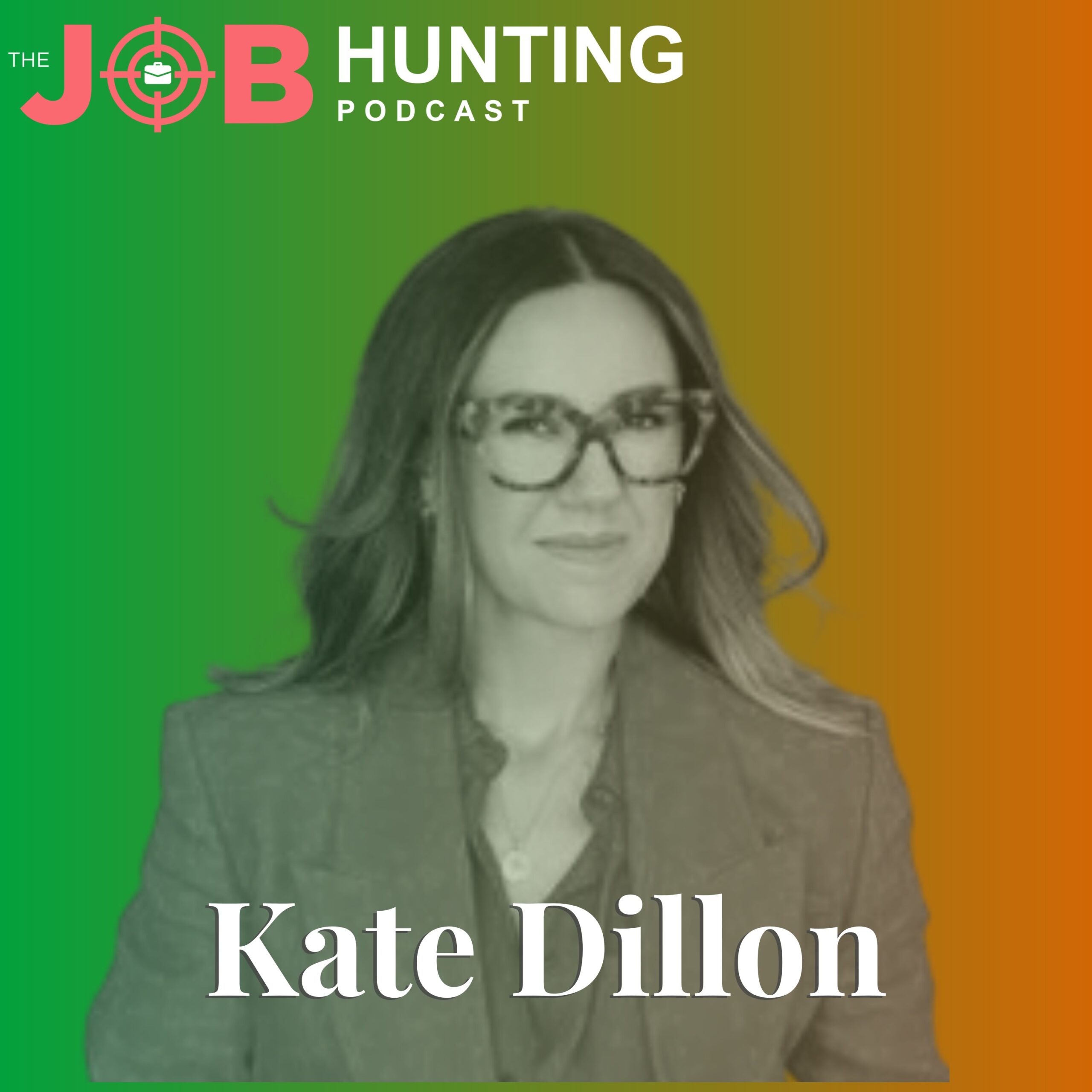
Kate Dillon is a speaker, advisor and creator of Opportunity Architecture. She helps organisations and their people get greater return from the value they already create.
With a background spanning law, enterprise strategy and entrepreneurship, Kate has built a consumer brand with international distribution, led strategy and transformation work inside organisations, and advised leaders and teams on how to make valuable work more useful, visible and consequential.
Her work starts with a simple idea: created is only the beginning. What happens next determines how much of that value is recognised, acted on and ultimately realised.
Her current keynotes explore three places to find more return from value already created:
Explore Kate’s keynote work here: www.katedillon.com.au/speaker

Hello, I’m Renata Bernarde, the Host of The Job Hunting Podcast. I’m also an executive coach, job hunting expert, and career strategist. I teach professionals (corporate, non-profit, and public) the steps and frameworks to help them find great jobs, change, and advance their careers with confidence and less stress.
If you are an ambitious professional who is keen to develop a robust career plan, if you are looking to find your next job or promotion, or if you want to keep a finger on the pulse of the job market so that when you are ready, and an opportunity arises, you can hit the ground running, then this podcast is for you.
Renata Bernarde: Can I just say this? Like when we met, like I’ve known you for a long time because Michelle Redfern always sings your praises.
Kate Dillon: does she that’s so nice?
Renata Bernarde: Yes, yes, yes. So she you know, she bought your bag and she spoke about it and talked about it. And then I think there was a limited edition blazer that you did. And I and
Kate Dillon: Yes, there was. There was, there was.
Renata Bernarde: I remember her gushing about it. And then we went to that Christmas party she did last year.
Kate Dillon: Yes.
Renata Bernarde: you walked in and I’m like, This woman is so stylish. I wonder who she is. You you
Kate Dillon: thank you.
Renata Bernarde: were wearing like a really lovely outfit and I’m like I really like that outfit. She is awesome. And then of course it was Kate Dillon And I’m like, that’s the famous Kate Dillon no, it
Kate Dillon: not famous, but that’s very nice.
Renata Bernarde: was really good to finally know who you were and and connect with you. So that was great. and I know you super busy. So thank you so much for making the time. But I this you’re the the right person to talk about this. Because the reason why I wanted to have you here, Kate, is because Kate, you have built this career that really refuses to fit into any box.
Kate Dillon: Exactly.
Renata Bernarde: Right?
Kate Dillon: Which does frustrate some people, but that’s okay. I think that’s part of it.
Renata Bernarde: let’s talk about that. Yeah. Look, your career DNA comes from being a lawyer first and foremost, as in the order of how things happen, right? Lawyer, then
Kate Dillon: Yeah, yes. Yes.
Renata Bernarde: a strategist, then a founder. and today you work across all of these things and across corporate strategy, you’re a speaker, you do advisory, you do mentoring. I think that most experienced professionals have spent years, if not decades, being told to pick a lane.
Kate Dillon: Yes.
Renata Bernarde: And you’ve done almost the opposite of that, right? So how do you
Kate Dillon: I have.
Renata Bernarde: do it? How do you build a portfolio career like that I mean I’m sure that you took some risks, but without looking like, you’ve run risks and and be becoming more and more credible over time, which is I I think really interesting to have observed. I mean, from far away we’ve haven’t met until last year. But
Kate Dillon: that’s very what a lovely compliment.
Renata Bernarde: I’ve I’m really been impressed and I wanted you to share that with the audience. So maybe we can start there.
Kate Dillon: That’s an excellent question. I wish I could say, with the benefit of hindsight looking back, it was so curated and strategic, and it all just led one thing to another. And that would be entirely
Renata Bernarde: Yeah.
Kate Dillon: incorrect. and I obviously need to lead with, I work with and for a very progressive law firm and have done for almost 13 years. And they, very unlike anywhere else that I have worked, have let me lean into creating roles where I could see where my usefulness would have greater contribution and grow commercially as I grew commercially externally. So it was win-win for both parties. So yes, absolutely, it’s a top-tier environment. you have to be providing value, you have to be profitable in inverted commas. for that to continue and there’s no like skating a at all. but there is an incredible opportunity to be very entrepreneurial. and should you see the business case and lead with a value proposition and be able to substantiate that you can back it up and follow through and create more opportunity from that. absolutely that’s been possible. And I think doing that internally because I was doing that externally has become mutually reinforcing and then almost like a pattern, a subconscious pattern that is part of how I operate. And I think being able to consciously decide what transferable skills you have, because as you say, we’ve absolutely told that you’re in a lane or you pick a niche. And I have always rebelled against that. And I know that’s the complete opposite of what you should do. but I’ve never fit into a box and I don’t think it’s the easy way necessarily to do what I’ve done. but it’s been the most fulfilling and challenging and best way for me to stretch because I think I’m obsessed with learning and I’m always want to understand more. And in doing that, to be able to move into spaces that are more difficult is actually really wonderful. and So that’s what I’ve continued to do. So I I can’t say wholeheartedly, you know, hand of my heart that I planned it all out. But I do think I’ve really honed my ability to look for adjacent possibility and what I now would call like a ghost pipeline, because essentially you create value all the time in different ways and in different forms, and you focus on the traditional way that you create value. And often we create the thing and then it’s finished and we don’t necessarily look beyond it. It’s delivered or it’s submitted or it’s handed over or whatever it is. But along the way, you have conversations that open up opportunities or you learn things that give you access to things that you wouldn’t have otherwise seen, or you come across a problem you’ve never faced before and you think, that’s really interesting. I wonder how that would relate to my context and whether that would be useful here.
Renata Bernarde: Mm.
Kate Dillon: And if you’re able to follow those patterns, often that makes where your lane is inverted commas much more valuable to whoever the receiver is of that value.
Renata Bernarde: Yeah. What I’m reading from what you’re saying is that you have a mind of an entrepreneur. many people wouldn’t sort of relate to that, but a lot of people would. And then you also had the right environment in an employer that was flexible and and willing to accommodate some some things. did you also work on surrounding yourself with the right people? and I’m also wondering here about your upbringing, how did your family and your close friends adjust to the changes that you’ve made in your career?
Kate Dillon: Also a good question. I think I have an incredibly supportive family. My brother died when I was young, and I think that dramatically changed the way I see the world. And I think that the silver lining of that is that you don’t take anything for granted and you do lean in and you do problem solve because you know, you experience someone very close to you leaving the earth, and so you think. you know, the time is now. I I will take the chance. You know, the worst thing that can happen is it’ll fail. and then I think that was exponentially made larger when I told everybody I was gonna do the New York Bar exam because I wanted to be a fashion lawyer. And I d you know, telling everybody is excellent because then everybody checks in and they’re like, How are you going? and they provide you with support. But I hadn’t really considered how beneficial it would have been to not tell people in the instance that I didn’t pass. And then when I didn’t pass. I don’t think I’d been as publicly humiliated like that ever before. but everybody just carried on. And that was the I think beyond having a having a sibling die, I think a really public failure for someone who hasn’t really failed anything quite like that before was really liberating because people people just are the protagonist in their own world and they have so much going on in their own they’re the main character in their life. And you know, you you pick yourself up and you you you you carry on and and I passed the next time. and then the GFC happened. So they weren’t hiring international lawyers so much at that point. And you know, you can’t always control what happens next. So I think it’s always about picking yourself up and saying, Well what what can I control? And and where should the journey lead now? Because it doesn’t have to stop.
Renata Bernarde: Hmm. I’m going to challenge you on something about you not you finding
Kate Dillon: Do, please.
Renata Bernarde: that you were not deliberate. I’m maybe Yes. Yes. Yes. I feel like you are very hard worker. Yeah.
Kate Dillon: I was deliberate in some in a in a sense I was very determined and very driven. Yes, absolutely. No and no, I didn’t float. I tr I work very hard. but I can’t say it was calculated, the second order effect. Yeah, yeah, yeah.
Renata Bernarde: And and maybe things, in you know, the pursuit of different lanes in the beginning might have been a bit jarring and and even a bit risky, but I think over time you became more resilient and more comfortable with okay, now I’m going to start something new. Now, you know, I know I can do this because I’ve done this before and you just became better and better and not worrying about failure, not worrying about what other people thought of you, right? Because you kept doing more and more different things.
Kate Dillon: I don’t know. I think I’m human. I still worry about what other people think of me. I still worry about failure. Yeah. I’ve been trained as a
Renata Bernarde: You do? Good to know.
Kate Dillon: lawyer. I’m like a perfectionist, but I think you o also
Renata Bernarde: Mm-hmm.
Kate Dillon: get to a point where you have to get over yourself and move forward and continue to take action. And I think when you take action you get more information and then you’re able to take a ne a better next step, even if you don’t know whether it’s the right step. As soon as you take the step, you have more feedback on whether you keep going in that direction or you need to course correct. And I think you can’t control what other people think of you, but you can control the experience that you provide other people and the value that you offer other people or how useful you are to other people. But ultimately you don’t control their perception. So again, it’s about sitting with the uncomfortableness of you’ve done everything that you can to be useful, to create value, to create a positive experience. But if it’s still not right, then it’s not right, and then there’s so many other people in the world. So move on to the next person. but you
Renata Bernarde: Yeah.
Kate Dillon: can’t control what other people think of you. So it’s it’s a very hard thing to if you remain focused on that because it’s not something you could ever control. So it will irritate
Renata Bernarde: Yeah.
Kate Dillon: you forever if you if you focus on it.
Renata Bernarde: Kate, the other thing I wanted to ask before we move on to more specific things is this idea of having long term plans. I’m very
Kate Dillon: Yes.
Renata Bernarde: curious to know by long term I mean like ten year horizons, right? So
Kate Dillon: Yes.
Renata Bernarde: okay, I’m going to create this fashion brand, I’m gonna do handbags, or I’m going to become a speaker, or I’m going to do advisory. How do you organize your ideas into plans? Are you a planner?
Kate Dillon: Yes and no. I think I’m
Renata Bernarde: Mm.
Kate Dillon: like a big picture vision person and then I’m very flexible with how I get to the outcome. And I am so passionate about success being subjective and relative to the individual and that you should own that wholeheartedly and that takes courage. And you don’t have to do the conventional version of success because success is whatever it means to you and your situation and your season of life and so I think that’s super important. But there was this incredible woman who was a business coach from Project Runway, which was so amazing to have been introduced to her when I first started the bag business. And she would always say, What is the professional legacy of the business? Like what’s the obituary of of the business? Like what’s what does she lion leave behind when you’ve died? Like what do they write about She Lion as opposed to Kate in the newspaper? You know, what is what is the big picture of you? And you know, you’re like, you know, it was an amazing handbag business and a lot of people knew about it. She’s like, no, what is like the global big blue sky, you know, it was an incredible movement and everything changed and there was a quality because of this handbag business. So pushing yourself to really be insanely blue sky and and then look making decisions focused on that really big picture vision. but then the elements that fall out of that in fact inform what you do in other areas of your life. So even though the bag business didn’t evolve into creating equality for the for the world.
Renata Bernarde: Okay.
Kate Dillon: it absolutely informed my decision to maintain working flexibly in a law firm environment, despite the fact I didn’t have children when I when I started. And so that was absolutely about serious feminism and demonstrating that, you know, you can have a very different career even in an environment where originally working flexibly was maybe seen as not being committed to leadership and not necessarily progressing
Renata Bernarde: Yeah.
Kate Dillon: and you’ve chosen to step out. and that absolutely isn’t the case. And then also I think having having a vision board, like really visualizing where you want to go, that doesn’t mean that it’s static and it doesn’t mean that it has to remain exactly that. Forever because y you’re a dynamic person and you evolve. And I think most importantly, you gotta be paying attention to what’s going on around you. So it’s this collab it’s calibration between where you are yourself and some self-awareness, but also the situational awareness and the playing field, and then this vision piece, the strategy piece and how they’re connecting, because reality always talks back to you and you’ve got to be paying attention or you completely miss the boat and then you’re not relevant into the playing field that you’re focused on. so I think it’s a continued check-in on, you know, am I am I still aligned with the big picture vision? Does it fit into the playing field that I’m in or that should connect to the vision? And then am I conscious of how I’m showing up and what I’m doing within within myself?
Renata Bernarde: Yeah, I love that. I want to talk to you about She Lion and the choices you’ve made. I’m going to compare it to two clients of mine. So
Kate Dillon: Yes.
Renata Bernarde: one client, C level executive woman built an entire business without no one knowing. Right? So she wasn’t the face of the business. She ne
Kate Dillon: Yeah, yes, yes.
Renata Bernarde: she still works full time as a C level executive.
Kate Dillon: Amazing.
Renata Bernarde: She has a business on the side running with ads and and and a lovely Instagram account and selling well, but nobody knows that she’s the owner of that, right? She she kept
Kate Dillon: Yes.
Renata Bernarde: it completely separate and that was her decision. Another client decided to build an app. Okay, created this amazing app and he was going through amazing interviews, got to the final stages, made was made an amazing offer, and he said no. And I was like, Are you sure? And he said, No, no, no. I want to spend time, dedicate at least two, three years to this business idea. And if it doesn’t work,
Kate Dillon: Wow.
Renata Bernarde: I’ll go back to the corporate world. And I’m like, Okay. You Are kind of the in-between between those two situations, right? Because you built She Lion on your handbag business while you were working at the law firm and where you still work, you still work at the law firm. Why did you choose to build it alongside your career? And did you ever consider leaving your employment or not letting people know that you were doing it? I’m wondering what was going through your head when you were making those decisions.
Kate Dillon: So those ones were less intentional, I think.
Renata Bernarde: Mm-hmm.
Kate Dillon: so I was a traditional lawyer, and I wanted to be a fashion lawyer, and I was in financial services and collapsed agri schemes. and I worked for an amazing man. and he knew I wanted to do that, and so he kind of supported me while I was studying for the bar exam, went to America, and finally got admitted. and then the GFC happened and so that wasn’t they weren’t sponsoring international people and and he very kindly was like, I I will support you moving into an IP practice at a top tier and happy to give you an amazing reference. and he was he was just ver incredibly supportive. and so moved into an IP practice and it was closer to fashion law, but it’s it was not in fashion. and so then I left to start the handbag business and you kinda make those decisions you know, that was a gut decision. That was like a a gut decision, like a good brisky decision. and I went and that was leaving the law and then my husband was like, Gosh, you know, you you you were getting like a decent wage in The law firm and the handbags, you know, they’re starting. You you haven’t yet made a handbag, you have to learn how to make them, you have to go and design them and get them produced. I think that’s gonna be like a couple of w you know, while runway. Maybe we could do some part time legal role in the meantime. And
Renata Bernarde: Mm-hmm.
Kate Dillon: I hadn’t really considered that. And then my dad was like, yes, look, there’s this ad, I’ve seen it, looks really good. There’s this firm in Melbourne, they’re bigger in Sydney, but like maybe check it out. And it wasn’t really a big thing to work flexibly thirteen years ago at all.
Renata Bernarde: No, no.
Kate Dillon: and so there was a a professional support Yeah, yeah, no, yeah.
Renata Bernarde: Especially in law, Kate. Especially in law. Yeah.
Kate Dillon: So there was a professional support lawyer role and I applied and it was perfect. It was you know, drafting kind of boilerplate clauses in contracts three days a week, which was perfect. And then continued building the handbag business. I think about six months after that I said to people at the firm, you know, if you’d like to come along, I’m gonna launch a handbag business. which they were a bit surprised with ’cause a lot of people originally and i everywhere assume when you work flexibly that it’s for a health reason or a well being reason or a family reason, thirteen years ago, not now. and I’d had a business baby versus a human baby and everybody was surprised that that was the case. Anyway,
Renata Bernarde: That’s it.
Kate Dillon: they’ve been incredibly supportive throughout that journey. And then I became energized by, well, why can’t I try and run a business that’s very lean and demonstrates my knowledge in innovation and commercial acumen? And then work flexibly in a law firm so there’s less pressure on the business but also more more ability to experiment and test. And very unintentionally the two became mutually reinforcing and taught me things in different environments that made me stronger in both contexts. And that was a big surprise. And that was a fabulous learning experience again because I love learning. And so I suppose I held on to that and have continued to hold on to that because experiences learned in trying to get a widget to market and really scale that, understanding not just the product you’re creating, but the business you’re creating around that, give you very different information to legal expertise and the kind of hidden infrastructure that you don’t notice when you are the lawyer. in that amazing machine until you’ve you’ve stepped out of it and tried to build not an equivalent in any way but an a a business as well and then you bring all these elements back in because in a legal environment value or your work is tested by scrutiny and judgment and hierarchy and usually the client has already come to the partner and so you’re developing
Renata Bernarde: Mm.
Kate Dillon: the expertise to give that to the next lawyer or the partner that eventually goes to the client that has to be you in a form that’s useful to the client. Whereas, you know, you could spend ages on perfecting a beautiful handbag, but there’s there isn’t a client that has come to the partner that wants the handbag essentially in that space. You have to create the awareness. And so people people are informed more by choice. And you know, they could buy this other perfectly good thing as opposed to your handbag. And so yeah, I became really fascinated about what happens after the thing
Renata Bernarde: Mm.
Kate Dillon: is created and how to get more return from that. And the two environments were were very educational because they were
Renata Bernarde: Mm.
Kate Dillon: so different but then all of a sudden so similar.
Renata Bernarde: That’s so interesting. Yeah, I hadn’t considered, you know, the the symbiosis of r d doing two things at once and then having both of them being enriched by what you’re, you know, experiencing and and and that’s a beautiful way to put the concept together. So thank you for that. I’m wondering here if You know, a lot of people have ideas. I have lots of ideas. many of my ideas just die the next day because I don’t pursue them. And I’m wondering here if from your experience you have maybe conceptualized or or you could mentor us on how we can pursue ideas. You know, if someone listening has a corporate job and thinks, I’d love to pursue this idea of maybe creating something or maybe consulting and doing advisory, what would you suggest that they do as maybe a small experiment that they could run before they step into the unknown completely?
Kate Dillon: Yeah, absolutely. I think first and foremost, if you are employed, it’s about having a really good relationship with your manager and being very
Renata Bernarde: Mm.
Kate Dillon: transparent about that so that you don’t get in trouble for doing anything. because we’re in an environment now, I think, where it’s much more acceptable to sort of have like a gig economy approach to work and more of a portfolio approach to work. But often in an employment arrangement, you are quite restricted and so you need to have the conversation so you don’t get yourself in trouble. But absolutely testing things where like creating a little a little site to provide the offering and see if someone actually goes to add to cart or making it a really low value offer or something where they actually need to take a step to validate that they would buy it, as opposed to other people saying, it’s excellent, it’s great, it’s so wonderful. Do do people actually put their money where their mouth is, to show interest. And then and then you’ve got a real like use case that that there’s there’s some great feedback there that maybe you should pursue that further. but it’s also that old thing of you know with Henry Ford and you know people saying they wanted faster horses and he was producing cars, you know, people also don’t know what they want until they see it. so it’s a catch twenty two. I think Absolutely, it’s about paying attention to reality and what the feedback is. So sensing and steering as a very intentional, what was the reaction? Was there interest? How much further can I push that to see if that you know someone would really ta put money behind that to pay for that? is very useful. But I mean I I did not do that with Sheila.
Renata Bernarde: Yeah.
Kate Dillon: I was my customer and I
Renata Bernarde: Yeah.
Kate Dillon: just had such a big frustration at not being able to find a handbag that wouldn’t break and that would carry everything that I needed. I I did not do a deep business case or test. I really jumped straight in. but with speaking of being a lot more intentional and strategic about making sure the value offering is useful and appealing and compelling and distinctive. So maybe it’s a learned skill, Renato. I’m not sure, but I can’t say I had it from the outset. But I think you should test. I think you should jump in,
Renata Bernarde: Think yeah.
Kate Dillon: but be transparent about it in a way where you can build up.
Renata Bernarde: Yes. I think, you know, if we explain to people listening what She Lion was all about, when you came out with your handbags for corporate women, there were no handbags for corporate women, everyone. There were no handbags for corporate women. It was
Kate Dillon: No, they weren’t then. No, yeah. Yeah.
Renata Bernarde: just She Lion. There was nothing else out there except Exactly. So you
Kate Dillon: Yeah. And now there’s air there’s so many options.
Renata Bernarde: set the ball rolling, you know. I don’t know that in in your goals for your, you know, blue sky, big picture, you would think I’m going to start something and others will follow. But that’s what happened, right? Once you
Kate Dillon: No, it’s nice.
Renata Bernarde: created the product, everybody went, of course. I don’t wanna, you know, carry the same bag as my, you know, male coworkers. I want something feminine and and fashionable and and beautiful to look at that’s aesthetically pleasing and that makes me proud and and that’s what you created and it looked absolutely amazing. and now I don’t know how many years was that was it a decade ago Kate that yeah now
Kate Dillon: Yes, it was. Yeah.
Renata Bernarde: we have options that we didn’t in the past we didn’t
Kate Dillon: Yes, yes.
Renata Bernarde: have any of that in the past. So you have this amazing foresight and I guess mission accomplished. You now moved on and now you have maybe I’m assuming created an an advisory that brought out of those experiences, right? Of having
Kate Dillon: Yes, yes.
Renata Bernarde: run a business, having worked with an employer and created those boundaries between employment and and outside work, dealing with Expectations, reputation, time, all of those things. And and now you’re into this other phase where you still work in a law firm and now you work with service provision instead of products. Yeah.
Kate Dillon: Yeah, yeah.
Renata Bernarde: So what conversations do you think people should have with employers or maybe with mentors or people that have already done things that they want to do, maybe they’re a few years ahead, you know,
Kate Dillon: Yes. Yeah.
Renata Bernarde: that couldn can be how helpful and and and did you do that? And and what
Kate Dillon: Yes.
Renata Bernarde: would you recommend? How would you approach people? You know, I think it must be a very awkward conversation, especially with employers.
Kate Dillon: I have been very fortunate with the different managers that I’ve had along the way. I think being candid is a superpower. because you don’t want surprises in that sort of space. You want to say, I’m really interested in pursuing this. Obviously thinking about what you’re talking about, it needs to be non competitive with the business that you work for, otherwise obviously that will not work. so handbags was very much non-competitive with law firms. Speaking is is n still non-competitive, but it’s kind of a closer service offering. So I’m very conscious of being very transparent with my manager about that. And I obviously don’t talk to private practice lawyers at all, because I work in a private practice law firm. but I think yeah, I do I do think it’s about having the conversation, say I’m thinking about pursuing this so that they they understand. And if you’re honest about that, then there’s no nothing covert, nothing underhanded that can be assumed when it’s not the case. And then I think you have greater freedom to go and test and experiment and learn. I absolutely was very intentional about picking people who had walked paths that were in some way aligned with where I wanted to walk. Think that old saying, which I’m sure I’ll get wrong, is that you don’t want to take advice from people who haven’t been in the arena where you want to go. because everybody has advice for you. so I really wanted to talk to people who had scaled a bootstrap business in retail and and how they’d done that. I wanted to talk to people who were at the top of their game in handbags. I I actively collect speakers who are incredible, who I want to be like. Equally, I am very conscious of surrounding myself with lawyers and partners who I think are incredible operators who I want to learn from and draw from. You you totally are the product of five, the five closest people that you associate with, I think, dramatically inform the way you think and what’s possible. And if they’re pushing and higher and expanding and can see opportunity. It’s almost like an osmotic effect on you where you start thinking, Well, I should give that a go. And why shouldn’t you? You absolutely should. and I think you become more attuned to looking for that adjacent possibility. And where’s the stretch zone? And yes, it’s gonna feel uncomfortable, but you get more comfortable feeling uncomfortable the more you do it. so I I think I I think I would. I ha you know, when I was in law, I had like a moment where maybe I just need to work in fashion. And so I decided I’d go and have coffee with a whole lot of people in fashion whose jobs I liked while I was a traditional lawyer. I went and did this. And you know, I thought fashion buying is so sexy, maybe that’s like what I wanna do. And so I went and like identified all these like amazing people with jobs that I thought was really cool, that businesses that I thought were really excellent. And brought my CV along, you know, with the view of maybe they’ll read my CV and they’ll be like, yes, this is you are who we’ve been looking for. And so funny that you should mention this. And that didn’t happen. mostly they said, you know, why would you want to do that? You know, you’re very overqualified. You’d be starting right at the bottom. Like, I don’t understand, you’re a lawyer. Why why are you talking to me? but absolutely it was like a cold. It’s better if you can have a warm introduction, but absolutely reaching out and saying, you know what, you’re someone I admire. I think your career journey is so interesting. I’d love to take you out for a fifteen minute coffee and now Zoom is, you know, also possible. just to pick your mind, would you be comfortable with that? I mean, you’ve got to be conscious of how, you know, you do that once to someone and make sure it you’re not like leaning on them too much. You do it you know, you do it once. But I don’t see why you can’t do that to a lot of different people to learn from a lot of different people. And I think
Renata Bernarde: Yeah.
Kate Dillon: from doing that, a a friend of mine told me about that, another lawyer. She she transitioned into media and journalism and she’d done something similar to that. And so absolutely I I was like, that’s an excellent idea. I’ll go and have coffee with a whole lot of people and get their advice on what my next step should be if that was the case and it became quite clear that actually I think I probably wanna just start a handbag business. So
Renata Bernarde: I love that. I think that it’s really interesting that as we get older we feel less less capable of s experimenting because we have I understand we have responsibilities and bills to pay, yada yada, I get it. But those projects are so important because sometimes we romanticize ideas, right?
Kate Dillon: Yeah.
Renata Bernarde: about what we could do or what what would life be like if I had done X, Y, and Z. And then it it isn’t until you inv investigate further that you realise, mm, you know what? Nah. It’s not for me. Or maybe this is the right path or okay, this is interesting, but I need to adapt it. So I I think especially when I work with clients that are in transition, which is most of my clients by the way, when between jobs, it’s a perfect time to to engage in that project and really consider ch do I want to be a consultant or do I want a permanent role? Do I want to be a business owner or do I want to work for an employer? Yeah. Yeah. Yeah.
Kate Dillon: You can do both now. You can be fractional and a consultant. You can do any version of anything. Like the your only limit is your imagination. And the candid
Renata Bernarde: Yeah. Yeah.
Kate Dillon: conversation that you have to lean into that may be uncomfortable to begin with.
Renata Bernarde: Exactly. And the other conversation that’s a little bit uncomfortable, but I feel like I really need to ask you is about making it financially viable, right? Because I
Kate Dillon: Absolutely, yeah.
Renata Bernarde: think people underestimate how long it takes before a second professional stream actually produces meaningful income, or if you decide it’s going to be your main income, you know, i even more so you have to really be conscious about maybe being overly optimistic about how
Kate Dillon: Yes.
Renata Bernarde: long it will take until you can make a profit. and also
Kate Dillon: Which is why yeah, which is why going back to the firm was so appealing for my husband to begin with. And then it became
Renata Bernarde: Yes, yes. I get it now.
Kate Dillon: like the fantastic threshold where there was less pressure because in a widget business and also I suppose in a speaking practice, you’ve got to continually create the visibility and the expertise awareness and the pull, the market pull consistently, you have to be going out and grabbing that and manufacturing that and making sure that continually happens. And if you stop doing that, it will stop coming as much as it was. So unless you continue to prospect and build and market and be out there, it it doesn’t continue at the same level. Whereas in a law firm environment or in a in a in a job, But in a law firm environment, you have a whole artillery around you that is doing all that work for you, which you don’t necessarily notice. And so the work keeps coming to you, same as if you worked for an employer anywhere. But the what interests me is I hadn’t really noticed how much more was going on around me until I stepped out of that. because we’re all kind of focused on our own lane, so to speak, or our own task within the within the thing. But it’s not until you try to build the whole ecosystem and naively think, you know, I’m gonna create something amazing and it is really beautiful. And just like the legal work is all about the work. It’s gotta be, you know, beautiful quality. It’s gotta be, you know, exceptionally sharp. It’s gotta be commercially relevant. It’s gotta be relevant to the context it’s going into. And you do that with a handbag. And like I had a launch event and I completely forgot to ask any journalists. Cause I just didn’t think about the fact that I needed a w you know, that part of it. And you don’t know what you don’t know.
Renata Bernarde: To promote it.
Kate Dillon: And I was really lucky that someone from the Herald Sun was married to someone who came and they were like, This is fantastic. And then it got put up on nine MSN dot com or something equivalent to that. but that
Renata Bernarde: Yeah it is.
Kate Dillon: was lucky. Like that was really lucky.
Renata Bernarde: Yeah, well it’s networking. It’s it’s it’s you know, it’s luck over time, compounded luck over time. Because it didn’t it didn’t look
Kate Dillon: Everything is relationships. Yeah. It is. But I think it’s I think yeah.
Renata Bernarde: like that. As somebody who was in Melbourne at the time, living in Australia, it looked really seamless. It looked like it was meant to be, you know, the promotion and and I remember seeing it and Yeah. Got it.
Kate Dillon: Everything after the everything after the launch was absolutely because at that point I was like, I need a business coach because I don’t know enough about the ecosystem of
Renata Bernarde: Okay.
Kate Dillon: retail and luxury and social media and all of the many, many other jobs that would be part of a business like that. but you don’t know what you don’t know. And so often when you fail like that, it’s much more informative than when you succeed or you look back and it was lucky and you don’t realise that it wasn’t actually perfect, it was luck.
Renata Bernarde: That’s good that’s good reality check t for for the listeners, I think, Kate, because When we think about being our own boss, you know, there is this sense of freedom and flexibility. I’m going to be a consultant or I’m going to open my business and I will just do it everything my way and the way that I want to do it. But there’s just so much you don’t know. So, you know, making sure that you surround yourself with the right support, which sometimes can be costly, you know, you have to invest in that.
Kate Dillon: Yeah.
Renata Bernarde: And the other thing is many people want to do all of that, but they need to l learn about cash flow, be good with numbers and and
Kate Dillon: Yeah. Yeah.
Renata Bernarde: and be financially savvy in order for that business to to move forward. So was that something Yeah, yeah. And the other thing to sorry, go ahead.
Kate Dillon: Your break even point and all that type of stuff. Yes, absolutely. I think No you know you go, you go.
Renata Bernarde: I the other thing too is that This I don’t know if you agree with me, but you know, I left my corporate career and I am doing this now. Like here I am, podcasting and and coaching
Kate Dillon: Yeah, amazing.
Renata Bernarde: and working for myself. But I I wouldn’t call it a lifestyle business. I still need to earn money, but
Kate Dillon: Absolutely.
Renata Bernarde: I th the the idea here is like I don’t want I don’t want to be a a millionaire or anything like that. I just want to have things done this way. It’s more important to me to have this lifestyle, to have this flexibility, and I’m
Kate Dillon: Yeah.
Renata Bernarde: willing to learn how to operate independently as a business owner and understand that like you said, I have to sell myself and promote what I do constantly in order to keep a pipeline of clients coming. So I’m willing to, let’s say, pay the price. I don’t think it’s paying the price. I actually do enjoy it’s a trade off. Yeah. Yeah.
Kate Dillon: Yeah, it’s a trade-off. Everything has a choice. It’s a trade-off. Yeah, yeah. But that’s the success’s subjective piece. So your definition
Renata Bernarde: Uh-huh.
Kate Dillon: of success is excellent and it’s wonderful. And you’ve articulated it and then you’ve designed your your career and your lifestyle around it. Like that’s perfect. That is perfect. That is essentially also what I try to do too. It’s what what what what are you trying to achieve? What will that look like? Where Where can you provide value that you can monetize? Where is there a bit less pressure that you can make that as a consistent stream? And where do you have the opportunity to experiment? And then what’s required to make that continue? and
Renata Bernarde: Yeah.
Kate Dillon: then how do I pay attention to reality to make sure I course correct so that I’m still in the right position all the time? To be honest, I think it all comes down to being really clear on your positioning and then continuing to build relationships in unexpected spaces. because if you are very conscious about where you sit and and and where you can provide the most usefulness or value, it kind of naturally follows from that. And I I don’t know that I came to that realization until much more recently, and that would have been more useful earlier. but then also being comfortable articulating what you want and then also owning what you can do. And framing it in a
Renata Bernarde: Mm-hmm.
Kate Dillon: way, well, what would people pay you for? Which is a Michelle Redfern thing is such such a clever reframe. rather than
Renata Bernarde: Yeah. Yeah.
Kate Dillon: what do you do, what do people pay you to do, or what do people pay you for, actually forces you to think about, well, what’s the transformation that you create for other people? whether that’s through a product or a business or an advisory or a service or expertise, whatever that is. but getting quite clear on that, and then I think continuing to build New relationships in unexpected spaces, which is where opportunity pops up and you get inspiration and you remain creative and you remain flexible and you continue to stretch your perspective.
Renata Bernarde: Mm-hmm.
Kate Dillon: that seems to be a very useful way to continue
Renata Bernarde: Yes, yes.
Kate Dillon: to grow.
Renata Bernarde: I like that. Michelle has been on the podcast twice, so I’m going to put below the links to the episodes with Michelle Redfern, who who Kate just mentioned before. But she’s very good. And and
Kate Dillon: Yeah, she is amazing. Yeah. Yeah.
Renata Bernarde: the other thing that I think is important as well, Kate, that I’m I was thinking as you were talking, was this idea of especially now that you’re a speaker and you’re an advisory, it seems like you haven’t Even with She Lion, you haven’t ever started from scratch. You’ve built on top of you know the layers of your career, right? So you were a lawyer, then you used law to sort of create your business, and now you moved into and you know, from entrepreneurship to strategy and advisory work without starting from zero every time. I think this is really important for the audience here because my my listenership and my clients are professionals over 40. They can afford to start from scratch many times. No. Okay. So how did you do it?
Kate Dillon: But no one does. No one does. Yeah. Cause you don’t go into I think do you know what? I love that you said that. Thank you. It’s so very validating. because I’ve only recently landed on, I think, the essence of what I do. And it is to get greater return from the value you already create. That is that is what I do. but I think everybody does that. And I think they’re they’re just not so conscious that they do that, because it’s not like You finish a role and you rock up at the next role with a clean slate and you bring nothing. You bring all of the history and experience and muscle memory that you have from multiple different spaces. It’s just about being more conscious of which which of those muscle memory reflexes and experiences you can repackage to be more useful and distinctive in this new environment. And and
Renata Bernarde: Mm.
Kate Dillon: everybody has something very, very valuable to bring. from another space, it’s just being more conscious of what those transferable skills are and how you can leverage them to get more impact and influence in the space that you’re wanting to pursue.
Renata Bernarde: Yeah. And based on that, I must I don’t know if you agree with me, but this sort of thinking isn’t for everyone. Right? This sort of no, no.
Kate Dillon: Sure. No one is for everyone. Yeah. Yeah.
Renata Bernarde: And if you were to sort of identify the ideal candidate for the sort of career where y it is a portfolio. There’s a l you know, you
Kate Dillon: Yes.
Renata Bernarde: you you keep building on on it over and over and you have several professional interests. It some people might find that overwhelming or distracting or, you
Kate Dillon: Yes, yes.
Renata Bernarde: know, it it’s too much. so how what is the ideal candidate for that type of career, the one that you have right now?
Kate Dillon: I think someone that gets restless when they’re not learning and being stretched. probably
Renata Bernarde: Yeah.
Kate Dillon: someone that’s really good at problem finding, problem solving and has strong self starting skills. I think someone that just enjoys testing their resourcefulness.
Renata Bernarde: Mm.
Kate Dillon: But increasingly I wonder whether we’re moving that way. with everything with AI and definitely in a knowledge space, I think that we’ll become increasingly more of a focus on skills rather than roles. And
Renata Bernarde: Mm.
Kate Dillon: pulling groups of people together that have skills to execute a project as opposed to roles and that may obviously I hope still happen in businesses as opposed to in marketplaces. but yeah the Anna Mackenzie is amazing. She writes all this incredible information on portfolio careers and actually puts structures together and trains people on those things which I didn’t have access to when I embarked on this journey but she articulates
Renata Bernarde: When you started you know
Kate Dillon: it so well as definitely someone worth interviewing or or looking up.
Renata Bernarde: Okay. We’ll have a look
Kate Dillon: Online. Yeah.
Renata Bernarde: at that. And it part of it what you were just saying about AI and and and what happens when you know you you sort of have to adjust to that made me think of the sort of things I read from your website as well and the the work that you do in advisory. where you argue that valuable work can disappear inside an organization, can just sort
Kate Dillon: Yeah.
Renata Bernarde: of evaporate for lack of air, for lack of your ability to influence the adoption of recognition. Yes.
Kate Dillon: not recognized in their world. It’s gotta be recognized and then it’s gotta be confirmed that it’s useful to this other person or to this other context or to this other department. And then they’ve want they’ve gotta wanna pick it up and take it further and build on it. So it’s gotta be low friction and understandable about what the next step is. It’s gotta be useful and usable. And then hopefully it it actually makes a difference in reality. And yeah, all these things
Renata Bernarde: Yeah. I
Kate Dillon: get caught between teams and Forums and levels.
Renata Bernarde: When I was reading that, I I thought about a client of mine who was telling me about, you know, AI adoption and implementation. A lot of organizations are doing that and and you know, the fact that some managers are coming to her and saying, now we can let go of this group or this person because you know, you’re
Kate Dillon: Mm-hmm.
Renata Bernarde: setting up AI for us. I don’t think we need that expertise anymore. And because she’s sitting next to this person, she understands how important and valuable the work that the person is doing, which
Kate Dillon: Does. Yeah.
Renata Bernarde: is not going to be replaced yet, at least by AI. And
Kate Dillon: Yeah, yeah, yeah, yeah.
Renata Bernarde: you know, I I’m wondering here if you have come across situations like that as well, where people are being overlooked in organizations and might have exited organizations only for organizations to then figure out, oops, you know, we’ve made a mistake here.
Kate Dillon: Yeah.
Renata Bernarde: we shouldn’t have restructured it this far. What sort of support are you providing organizations that are going through these massive transitions in the way that we work?
Kate Dillon: think it’s really important that we’re thinking about what are we what are we augmenting, what are we automating and what are we still owning ourselves. and part of it is redesigning how work is done because a lot of the way work is done, you can’t retrofit AI into it. It needs to change which elements are going to be handed over and which elements are going to be owned. And then you do get more of an efficiency and transformation piece. And ultimately there’s a lot of amazing businesses that have repositioned people in the business to do more amazing things and not lost people. And equally you hear a lot of stories about whole teams being made redundant and then the business deciding actually that was a mistake and then needing to hire those roles back.
Renata Bernarde: Mm-hmm.
Kate Dillon: it’s yeah, I mean a a AI is like this amazing new space. that i i there’s any sort of endless possibility and you can be you can’t really be glass half full or glass half empty about it. I think you just have to be very attuned and conscious and open to learning and including it in your in your life and in your role. yeah, I can’t say I have the answer to that one. I can’t there it’s yeah
Renata Bernarde: But do you think that there is something that the listeners could be building now that will still help them become sort of more competitive maybe five years from now?
Kate Dillon: Yes. Yes. I think the hardest thing that we have to learn is how to unlearn. I I think the way that we do things is going to change dramatically and we’ve got to be open to letting go of the way that we have for the way that it could be and maybe multiple ways that it could be. And again, it’s probably that level of comfort with uncomfortable, uncertain, ambiguous environments, like a ambiguity tolerance, if you will. And being more comfortable with that experimentation piece. So trying something and then feeling like, well, what did I learn? Did I win or did I learn? Like there’s no losing. There’s like a lesson or it succeeds. And then how do I take that lesson and apply it and grow from that?
Renata Bernarde: Okay. All right. So I have a closing question for you that I think is fun. It’s a project. Imagine somebody that’s listening here is in their mid forties, successful on paper, reasonably well paid, aware that they don’t want their entire professional future tied to one employer or one job title. They might have over time become a bit tired and lacking in energy from the career that they’ve built. What would you tell them to do but they don’t know what to do next, okay? So
Kate Dillon: Yeah, yeah.
Renata Bernarde: what would you tell them to do over the next twelve months?
Kate Dillon: I would tell them if they haven’t already done something like a Clifton Strengths assessment to do something like that because th those types of tools are really helpful to give you like language around the intangible talents that you have that you don’t know that you have. And I think
Renata Bernarde: I agree. Yeah. Yep.
Kate Dillon: that changes changes the frame for a lot of people. And once you’re able to change their frame, they see a whole new playing field. and they feel really empowered because this I mean no one can be put into a box and no one can be defined by an algorithm. But the Clifton Strengths Finder I think is incredibly useful to surface things that people take for granted and don’t realize are innate strengths that they in fact have. And then say
Renata Bernarde: No happen.
Kate Dillon: once you have that information, how would you like to draw upon that and use that more in your life and is that currently accessible in your role and how can you use more of that in your role? Or is there another way, another form that might take in a different space that you’d like to explore? And then maybe can you start exploring it? Can you go and do a short course? Can you go and meet with some people in that space? Can you do some investigatory interviews? Can you find out what a day in the life of this other person is? Can you start blogging about it? can you find industry journals on it? Or can you read more about it? Or how can you play? How can you put play? in there where it’s safe for you to fail, it’s safe for you to learn, it’s safe for you to validate out loud that that is in fact what you want to do, or it’s safe for you to work out that in fact it’s a little bit left of center to that. And and that’s great too. How can you take some action that’ll give you feedback? that’ll
Renata Bernarde: Amen.
Kate Dillon: give you more information about the next step.
Renata Bernarde: I love that you mixed a a few things that are introspective, like doing a strengths test. By the way, there is one on my website if you’re agnostic about which one, you know, I I offer a different one, not strengths fire. Mine c mine is called talent predict, so I’ll put a link below. and and a mix of that and going out and talking to people. I find that most people that are more mature, you know, in their forties and fifties. and they want something different, they can feel it can be quite vulnerable to be out and
Kate Dillon: Yeah.
Renata Bernarde: about talking to others, but I I don’t what’s the problem with that? Like you said, you know, it it you have to give it a go.
Kate Dillon: And you don’t have to fra it’s not it doesn’t have to be a dramatic I’m leaving
Renata Bernarde: Mm-hmm.
Kate Dillon: and I’m I’m going to start an entirely new thing. I think it’s really good to be able to dip your toe in the water. I don’t think you need to throw the bath out with the bathtub quite like I did and then come
Renata Bernarde: Yeah.
Kate Dillon: back and have the toe dip and the leg in each pond now.
Renata Bernarde: Yeah.
Kate Dillon: I think you can put your toe in the water and, you know, swirl
Renata Bernarde: Mm-hmm.
Kate Dillon: around and see what the ripples like and see whether or not it is in fact the pond that you want to go into. And I don’t think you n necessarily have to announce that you want to change. I think you just need to follow what fascinates you and s
Renata Bernarde: Yeah.
Kate Dillon: and see what you know, pull the thread on the jumper. Like let it unravel a bit to see if that is in fact
Renata Bernarde: Uh-huh.
Kate Dillon: the space you wanna explore more.
Renata Bernarde: There’s a little book. It’s I I call it an essay. It’s so tiny. It’s called Do the Work by Stephen Pressfield. I I always recommend this book. And it’s a very no BS kind of book, you know, just do the work. And and it it gives you very a very clear framework of what to do and what to avoid if you really
Kate Dillon: Yes.
Renata Bernarde: want to test the an idea. And I love it. I it’s very funny too. It’s it’s a good read. So I’ll put the link below if anybody’s interested. Yeah.
Kate Dillon: Sounds like a good one. Yeah, yeah.
Renata Bernarde: Kate, thank you so much for joining me today. I think it’s so important to show the listeners different ways of tackling work, you know, and understanding a career and understanding what is possible. So I I love that you came on board and you shared with us and I want to put the links below for people that want to reach out to you for speaking engagements, advisory work. you know
Kate Dillon: Thank you. There’s actually a value movement diagnostic they can do if you want. It’s free and it shows you where your greatest opportunity
Renata Bernarde: wonderful.
Kate Dillon: to move your value further is. so I’ll make sure you have the link
Renata Bernarde: okay.
Kate Dillon: to that too.
Renata Bernarde: Please, please, let’s add that to the show notes as well. Thank you so much, Kate.
Kate Dillon: Thank you for having me.

Join our ever-growing community of professionals who are taking their careers to new heights. Every Tuesday, I’ll send you The Job Hunting Newsletter, with the latest episode of The Job Hunting Podcast and other resources to help you make career plans that work.